Chapter one
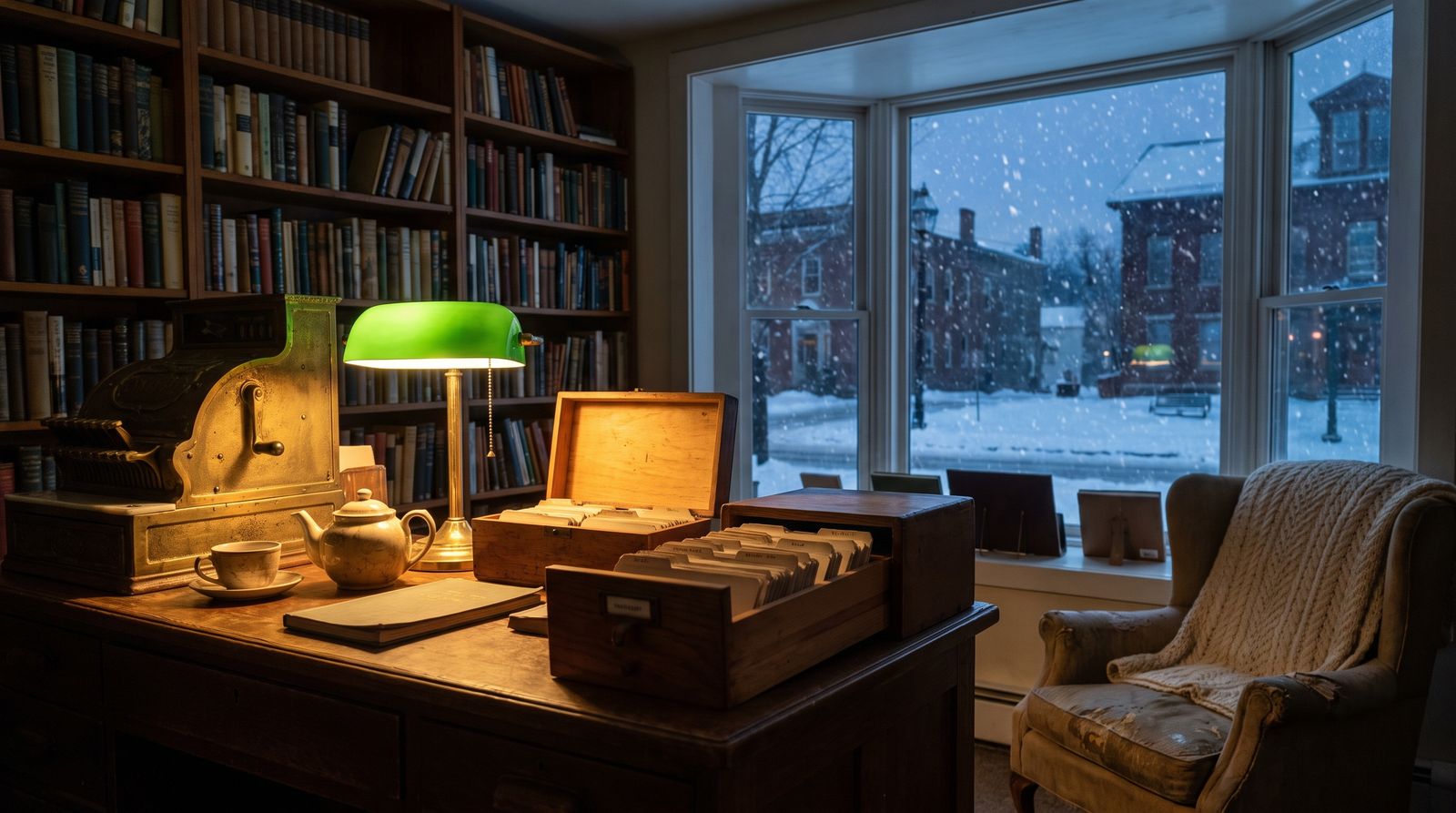
November 2027 made the shop smell like dust and old glue.
Helen Brig was thirty-five and she found Eleanor’s papers because a shelf finally gave up a false back. Not magic. Humidity and a shove. The mid-room case that had always been a little proud of itself—oak, a warp in the third board, a smell like lemon oil that had given up in February and come back in April and given up again—shifted when she put a stack of town histories where town histories lived. The stack was not heavy. The case was tired. The back panel clicked the way a latch clicks when it has been waiting for a person who likes queues and then for the niece of that person.
She stood with the histories in her arms and looked at the gap. Not a gap like Folio’s gap. A gap with a hinge that had been painted the same brown as the rest so a customer would not invent a mystery. Eleanor had painted it. Helen knew the brush because she knew the brush on the lintel and the brush on the stair risers and the brush on the frog by the alley door. Fussy. A vein that changed its mind at the corner.
She set the histories on the floor. Pepper sat on them at once, which was staff, which she allowed. She put her fingers in the gap and pulled. The panel came. Behind it: a shallow box the width of the case, lined with the same brown paper Eleanor had used for bookplates in 2019, and in the box, folders. Dates. A map of thefts that tied a Burlington collector to a town vote and a patch of ice behind the library in February 2026.
She sat on the floor with Pepper and did not cry, because crying would have smudged a page. The floor was cold the way November floors were cold when the grate had learned manners and the manners were still a rumor before nine. She had hung OPEN at nine, lift then left. She had counted the float twice. Honest. She had written the count on the scrap. She had written November, still a shop because April’s folder had said November would earn papers and November had arrived like weather, which was to say it had arrived without asking if she was ready.
She sat long enough for the folders to become a table in her head before they became a table in the office. She did not spread them on the floor. Spreading was how pages smudged. She opened each far enough to know its job and then she shut it. List. Label. Square. Quarto. Letter. She said the jobs so the floor would have a queue. Pepper scored the nearest folder and then lost interest, which was still correct. She moved him to the histories. She did not cry. She called. She sat. She waited for gloves. She sold paper around a wall that was still a mouth. That was the morning’s religion until nine-fifty. She could live with a religion that had a sheriff in it and a hinge in it and a cat on 1994. She could not live with weather as a verdict. Both were true on the same floor. She used both. She did not smudge.
The first folder was a list. Shelf marks in Eleanor’s slant. Titles that were not on any shelf Helen had priced. Dates in the margin that ran from 2019 to January 2026 and then stopped, as if a hand had put the pencil down and gone to a path. She did not read the last date as a speech. She read it as a queue that had been interrupted.
She read the list the way she read invoices, locate and assess, a finger in the air so she would not smudge. A Hollins cousin that was not the Hollins that had been a gap. A pair of plates marked sold to a period. A quarto that was not Folio’s quarto. A map that was not a map. A date in 2019 and a date in 2021 and a date in 2023 and G. asked again. said no in December 2025 and list to meeting in January 2026 and then the stop. She said the titles so the floor would have a time. Pepper sat on 1994 and did not help. She did not need help. She needed not to smudge. She did not smudge.
The second folder was a label. Forwarding. A Burlington address she had seen on a letter Patricia still billed. A name she had left as a period: G. The label had been peeled and saved, not thrown, because Eleanor threw nothing that might later sit in a room with a sheriff.
The third folder was a square. Cotton. A photograph of a corner Helen had already squared in a different November, quilt-show weather, a body that had not been this body. The square was not a clue she had to solve again. It was a habit saved in a wall.
The fourth folder was a quarto. Not the room’s quarto. A photograph of gilt and flour and a North Creek stencil, January’s crumb, already bagged in LATER downstairs. Eleanor had photographed a cousin before the cousin had arrived. Or Eleanor had known the cousin would arrive. Helen did not decorate that. She put the photograph back.
The fifth folder was a letter. Evelyn’s hand, the inn Evelyn, the one who had come in mud and had not left the way guests were supposed to leave. W. knows the ice is a story. Helen had a copy of that sentence in a drawer. She had not had the original’s cousins: bank slips with a selectman’s initials, a vote calendar with a line through a library sale review, a clerk’s tired accident report with ice in a box that liked boxes.
She sat. Pepper scored the nearest folder and then lost interest, which was correct. A cat on a folder was a cat. She moved him to the histories. He sat on 1994 and looked as if 1994 had been his idea.
She called Hugh Kline. He was thirty-nine now, a birthday she had marked with pie, not wine, and a kiss that had learned how to happen on porches. The pie had been Sam’s, paid for, not a toast. The kiss had been a porch and then a shop doorway at dusk and then, once, the green when no one was looking, which did not count as a green in the town’s minutes. Minutes could have a later green. This morning could have a wall.
“I’m coming,” he said. “Don’t go to the library ice. That’s a request dressed as a feeling.”
“I’m thirty-five. I’m going to the table. The ice can wait an hour.”
“An hour,” he said, as if an hour were a stamp. “I’m thirty-nine. I can do an hour if you stay a shop. If you walk to the path I will be professionally loud in a way that makes Dot put loud in minutes.”
“I’m staying a shop. The shop has a wall. The wall has folders. I’m sitting on the floor.”
“Sit. Don’t improve the folders. Improving is how you get a mistrial in a town that likes a chorus.”
He hung up the way he hung up when he was already reaching for a coat. She sat. She did not improve the folders. She looked at the hinge. She looked at the brown paper. She looked at Pepper on 1994. She wrote, on the scrap that had survived the float count, false back, mid case, folders, list label square quarto letter, do not smudge. The scrap was not pretty. It was a shop.
Molly came at nine-twenty with a cloth and November in the hem of a coat that had been Eleanor’s idea of practical and then winter’s idea of a joke. She saw Helen on the floor. She saw the panel. She did not invent a festival.
“Jenna said the diner’s doing first snow as a personality,” Molly said. “I said shops do paper. I didn’t say walls. I’m saying walls to you because you’re on the floor with a hinge and I’m dusting as if you aren’t. I’m a Monday. I’m not a special.”
“You’re a Monday,” Helen said. “Dust is allowed. Walls are a later I’m putting on the table. Don’t photograph the hinge.”
Molly dusted the spinner and did not photograph the hinge. Friendship that did not require a speech. Pepper stole the cloth’s corner and looked offended that the corner was not a folder. Molly moved him. He sat on the holds. Helen left him.
She did not close. Closing would have put a wall on the glass. She left OPEN. She left the histories on the floor because a customer who wanted 1994 could wait or could buy 2026, which was on the shelf and had learned to be this year’s Vermont. She wiped the brass from a kneel, which was not elegant and was honest. She counted the jar. Honest. The jar had not heard about a wall. She wrote the jar on the scrap under the hinge.
A woman wanted gravy and no trouble. Helen sold her a cookbook from the floor, which the woman accepted as a kind of weather. A man wanted the falls and would not walk to them in this. She sold him a map and did not get up until the money was in the drawer, and then she got up because money in a drawer from a kneel was how you became a review. She told a boy the cat was not for sale. The boy asked if the cat had found something. She said staff found naps. The boy looked relieved. She wrote cookbook, map, staff naps, hinge not on glass and left it.
Hugh came at nine-fifty. No hat. November on a boot he was not pretending about. Thirty-nine. He stood on the mat that said nothing because the shop mat had never learned WIPE; WIPE was Doreen’s. He looked at the floor. He looked at her face. He did not kiss her in a doorway that had a panel in it. He looked at her mouth and then at the folders, which was safer and also the job.
“Procedure,” he said.
“Folders,” she said. “I’m thirty-five. I sat. I didn’t walk to the path. I called. That’s the split so far.”
“That’s the split.” He put on gloves from a kit that had lived in his car since a package had ticked in September of a different year. He did not touch the hinge with a bare hand. He photographed the panel, the brown paper, the box, the folders in the order they had been stacked. He photographed Pepper on 1994 and then looked annoyed at himself and photographed 1994 without the cat. “Ruiz will want a second shot of the hinge. Ruiz is in Waterbury with a judge who likes white space. I’m first shot. You’re a shop. You’re also a niece who found a wall. I’m not mixing those in a report until I have to.”
“Mix them in the report,” Helen said. “Don’t mix them on the glass.”
He almost smiled. He did not. He crouched. He read the list the way he read a blotter: locate, assess. He did not read aloud. She did not need him to. She had sat with the slant. She knew the last date. She knew the stop.
“Eleanor hid a case in a case,” he said. “That’s a sentence I didn’t think I’d say before coffee.”
“You can have tea. The kettle is a kettle.”
“Tea after the photographs.” He photographed the label. He photographed the square. He photographed the quarto cousin. He photographed the letter and the slips and the vote calendar and the clerk’s tired box that said ice. He did not stack them prettier. Prettier was how twenties walked. “I’m taking copies. You’re keeping the originals in a drawer that isn’t a wall. The wall is done being a wall. I’m having Tom Goss send a man for a real back if you want a real back. I’m not sending Tom. I’m sending a sentence.”
“Send a sentence. I’ll pay the man. I’m not putting a hinge on a tab.”
“Good.” He looked at her again. The look held. One beat too long for a hinge. Not a lean. The kind of gaze that had learned porches and was not going to invent a stair in a mid room on a Monday. “I’m glad you sat. I’m glad you called. I’m not glad about February. I’m filing not-glad as work.”
“File it. I’m selling paper around it.”
“Sell paper. I’ll be back at close if close is a close. If it isn’t, I’ll be back when it is. Don’t go to the path. That’s still a request dressed as a feeling. It’s also a sheriff.”
“I heard both.”
He lifted two fingers. She lifted two. That was the briefing. He bagged the copies. He left the originals. He left the panel leaning like a door that had decided to be honest. He went to the cruiser. She stood in the frame until he pulled away, and then she stood a little longer, because the green in November was worth standing for: maple without opinions, a flag, Sam’s chimney already a fact, Fran’s smile in a window for a man named Baines, a shop that smelled like dust and old glue and lemon oil that had given up.
A woman from Fran’s watched from the sidewalk and then decided the show was only a sheriff with a bag. Helen lifted two fingers. The woman lifted a coffee. That was Heddleford’s idea of a briefing.
Inside, she put the originals in the drawer Eleanor had used for jobs that were not for a shelf. She put the panel against the case and did not nail it. Nailing was a man with a sentence. She stacked the histories back, not in the case, on the low table, because the case was a mouth until it had a back. Pepper sat on 1994 again. She let him.
She sat on the floor once more before the rest of Monday, not to smudge, to look at the hinge without the folders. The hinge was a hinge. The brown paper was brown paper. Eleanor had painted a mystery so a customer would see oak. A niece had shoved oak and found a queue. The queue was in a drawer. The hinge was a mouth until Ray brought plywood. She could live with a mouth for an afternoon. She could not live with a hinge on the glass. She stood. She wiped her hands on a cloth that was not Molly’s. She hung nothing that said WALL.
The rest of Monday insisted on being a shop.
Before noon the morning stretched the way November mornings stretched when a wall had spoken and a sheriff had bagged copies and a niece had stayed on the floor long enough to not smudge a page: brass, bell, paper, a cat who scored the wood and then the holds and then, briefly, the scrap. She moved him off the scrap. She counted the float a third time because a third time was how you kept a hinge from inventing a prettier number. Honest. The number had not changed. She wrote the number again.
Dot Sewell came with minutes that had open and November and not wall.
“Evelyn is putting first snow in and taking festival out,” Dot said, and then, because the town already had an Evelyn who did minutes and an Evelyn who had been a guest, “Minutes Evelyn. I’m not putting wall in until someone makes me. I’m putting Helen is a shop. If you need a table, you know a porch. I’m saying that as a woman who has given porches and then spent them watching people improve grief. I’m squeezing. I’m leaving before it becomes a toast.”
She squeezed Helen’s wrist, brief, the same squeeze as September and as April. She bought a bookmark she did not need. She left. Helen wrote Dot: November, shop, no wall, no toast and sold a garden book to Irene Cobb, who said her barn was still a barn and she was glad a shop could have a Monday without putting the Monday in minutes. Helen sold her the book. She did not sell her a hinge.
Patricia Holm called at one and said walls were how estates became sequels and she was still not a plot and Croft was still billed and a false back was a carpenter and not a lien and Helen should go sell a book. Helen said she was selling a book. They hung up. The phone sat. Pepper sat on it and was moved.
Lois Brant came with a question about whether the jar was still a jar if the shopkeeper had been on the floor. Helen said the jar was a jar. Lois put nothing in it and looked relieved, which was still progress. “Dot said November doesn’t get a tin,” Lois said. “I’m not bringing a tin. I’m buying a mystery with no swearing. I’m tired of the paper. I’m glad you’re standing. Standing is a typeface I like in a person who has a floor.”
Helen sold her the no-swearing. She wrote Lois: standing, no tin, no swearing and wiped the brass.
At noon Sam’s boy came with the loaf that was not a note, only bread, and a look that said Sam had heard a sheriff’s car at nine-fifty and had decided bread was the correct response. Helen put money in the jar because money in a drawer would have been a toast. She ate over the sink upstairs. The walk-up had learned manners in May and had not forgotten them. The grate was warm enough for a cat who was not on it. She stood at the alley window. Empty. She came down with crumbs. Pepper licked her cuff. She let the lick be a lick.
She sold a town history to the man from the falls, who wanted to know if a sheriff with a bag was a later he should take to a selectman. She said she sold pamphlets, not laters. He bought the booster. He said later without being asked, then asked anyway. She did not say Baines. She did not say G. She said later. He left with the pamphlet and the later. She wrote falls: pamphlet, bag later, no letter and left it.
At two she opened Eleanor’s desk book, not to match, to remember. The fussy pencil. The vein that changed its mind. G. asked. said no. folio not for sale. She did not copy the wall into the book. The wall had been the book’s cousin, hidden, a queue for a niece who would shove a case on a humid Monday. She sat with the missing until the missing was boring, which was how you kept a November from becoming a speech. Then she put the book away. She put her hand on the drawer and did not open it again. Opening twice was how folders became pilgrimages.
She walked the mid room. She reshelved the trains. She left Eleanor’s arguments. She stood at the glass and looked at Sam’s chimney and at Fran’s smile and at her own lettering from the inside, backward, and she turned back. She wiped the brass. She told a tourist the cat was not for sale and said it louder. She sold a garden book with soil in the gutter, honest, priced not pretty. She made tea in the shop kettle and drank it standing up. The tea was only tea. She did not take it into Folio. Folio was cooler. Folio did not need a Monday mug. Folio did not need to hear about a hinge.
She stood in Folio’s doorway anyway, a check, not a pilgrimage. The lintel shouted. The gap was a gap. The owls were ugly. The quarto said DO NOT SHELF. She did not shelf it. She told the room she had found a wall and the folio was still not for sale, and the room had been a woman who liked queues, and the room did not argue. She dusted the runner. She went back to the brass.
Walter Baines smiled from the diner glass. Fifty-eight. A smile she had not stared at in April and was not going to stare at now that a wall had given her his initials on a slip. She did not stare. She turned back. Turning back was a typeface she liked when a smile wanted to be a heading.
Tom Goss came at two-forty with a question about whether a case that had grown a mouth wanted a back that would not click. She said Hugh had sent a sentence. Tom said that was sensible and bought a map he did not need. “Ray Stoddard can do a back that looks like a back,” Tom said. “I’m not sending him until you say. I’m a floor. Backs are a later. If the later is today I have plywood that is not pretty and is true.”
“True is enough,” Helen said. “Pretty is how hinges hide.”
Tom nodded as if she had said something about salt. He left. She wrote Goss: plywood true, Ray later, map not needed and left it.
Rita’s substitute left the mail on the mat. Catalogs. Nothing tucked. Helen brought the pile in. The slot did not jam. Nothing in the pile was addressed to E. Wynn. Nothing ticked. Helen filed the not-ticking as a Monday she could live with.
The last hour did what last hours did when a wall had spoken: it tried to become a prologue. She refused the prologue. She sold a map. She told a tourist the cat was not for sale. She counted the jar. Honest. She stood in Folio and did not fill the gap. She told the lintel she had sat on the floor and the folio was still not for sale, and the lintel had been gilt by a woman who liked queues, and the gilt did not argue.
She sent Molly home at four. Molly said, “I’m taking a cloth. I’m not taking a wall. Jenna can have first snow. She cannot have a hinge.”
“Good,” Helen said. “First snow is Fran’s. Hinges are a drawer.”
Molly left. Helen stood in her lettering. The green was early dark the way November greens were early dark: maple, flag, chimney, smile, a cruiser that was not yet a roll-past. She hung CLOSED. She locked both locks. She checked the alley. Empty. She put a hand on the frog. The key was under it for a man with plywood if the man came tomorrow. She went upstairs.
Photograph straight. Pepper fed. Tea in Eleanor’s pot, not a ceremony. She sat on the quilt. She opened the notebook.
10 Nov. False back, mid case, humidity and a shove. Folders: list, label, square, quarto, letter. Slips W.B. Vote line through library sale review. Clerk ice. I sat. I did not smudge. I called. Hugh 39, gloves, copies, don’t go to the path. Molly Monday. Dot no wall. Patricia not a lien. Lois standing. Sam bread. Falls later. Goss plywood. Rita’s old route. G. still a period. W. still a letter I can now say is a man if I say it in a room and not on a flyer. See you at close, he said. Close is a close. Still a ceiling. Pepper a cat. I am thirty-five. He is thirty-nine. The shop is a shop. That was the point.
She did not write an ending. Endings were for manuscripts you could support. The wall was supported. The sitting was supported. The not-walking to the path was supported.
He came at close that was a close, which was five, which was dark. She let him in the alley because the front was CLOSED and the green did not need a second briefing. He stood in the kitchen that had been Eleanor’s and was Helen’s. He had no hat. He had a folder of copies. He had the face of a man who had spent an afternoon with a judge’s clerk who liked white space and had gotten enough white space to start and not enough to finish.
“I’m not staying,” he said. “I’m putting the copies on your table so you can see what I see. Then I’m going to a desk. Then I’m rolling past if you want a roll-past, or I’m not if you want a kitchen. I’m asking which.”
“Kitchen,” she said. “Then a roll-past anyway, because the green likes a habit. Then tomorrow.”
“Tomorrow.” He put the copies down. He did not reach for her hand until the copies were square. Then he did, logistics and something else. The something else had learned porches. It had not learned a stair. She was glad. Some things should stay on porches until a case sat down, and this case had only stood up.
They did not kiss in the kitchen. They had kissed in kitchens since April, small, adult, tea, not a heading. Tonight the copies were the heading. She looked at his mouth. He looked at hers. The save held on purpose.
“I’m scared you’ll walk to the path at six because six is dark and a path is a feeling,” he said.
“I’m scared I’ll walk to the path at six,” she said. “I’m not going to. I’m thirty-five. I can want a feeling and use a table. Different wants. Same floor.”
“Same floor.” He squeezed her hand and let it go. “See you tomorrow.”
“See you tomorrow.”
He went down the alley. She locked both locks. She checked the window. Empty, then a cruiser at the far end of Main, a roll-past that was a habit, two fingers she could not see and lifted anyway. She turned off the kitchen lamp. Pepper took the quilt. She sat until sitting was boring, which was how you kept a Monday from becoming a speech.
She thought of the hinge. She thought of the last date on the list. She thought of a smile in a diner glass. She thought of ice that had been a verdict and was now a folder. She did not go down to open the drawer. She did not walk to the library. The library could wait until a table had done an hour, and then another hour, and then a witness Hugh could put in a room.
November, in Heddleford, had earned its papers. She had shoved a case. The case had given up a back. She had sat. She had not cried on a page. She had called a sheriff who was thirty-nine and had come with gloves. She had sold paper around a wall. She had hung CLOSED. She had said tomorrow. She slept on the tomorrow without opening the path. Opening the path was a later chapter’s job if a later chapter wanted a job. This chapter’s job had been a hinge, and a floor, and an hour. She had done the hinge. She had done the floor. She had given him the hour. She let them hold.
She listed the day so the notebook would have a queue if the morning forgot: hinge, folders, sit, call, gloves, copies, brass, gravy, falls, staff naps, Dot squeeze, Patricia lien not, Lois standing, bread, desk book shut, Folio check, smile not stared, plywood true, the mat, kitchen, hand, no path. She did not decorate the list. She let it be a Monday.
She thought of the pie in July, Hugh’s thirty-ninth, a porch, a kiss that had not needed a speech. She thought of April’s may I and yes and a moth at a bulb. She thought of a ceiling that had held through a dealer, a mailer, a quilt, a bag, a tub. Heat 2 was a later if they lived through a selectman. Heat 2 was not a Monday floor. She let the ceiling hold. She slept on the holding.
The Fenwick House fox gathered dust downstairs, no memoir, no Manhattan. She left it, even in her head. She left the owls. She left the quarto that said DO NOT SHELF. She left G. as a period. She left W. as a letter that had become a man in a folder and not yet a man in a room. She left Claire as a name said on a porch in April, not a shrine. She left Eleanor as queues and slant and a false back painted brown.
She would be here when the table finished the hour. She intended the finishing to be paper. She intended Hugh to do the warrant when a warrant had a witness. She intended not to put a smile on a flyer. She was learning. Learning was a typeface she liked. She slept on the learning without walking to the ice. The ice could wait an hour. The hour could become a week. A week could become a stamp. She let the waiting be winter, which was a personality, and she did not make the personality a pamphlet.
Monday held. She let it hold. The drawer did not file a report. The path did not get her boots. The shop was a shop. That was the point. She slept on the point, and Pepper blinked, or she invented the blink, and she took it as a lease that had found a wall and had not sold the cat.