Chapter one
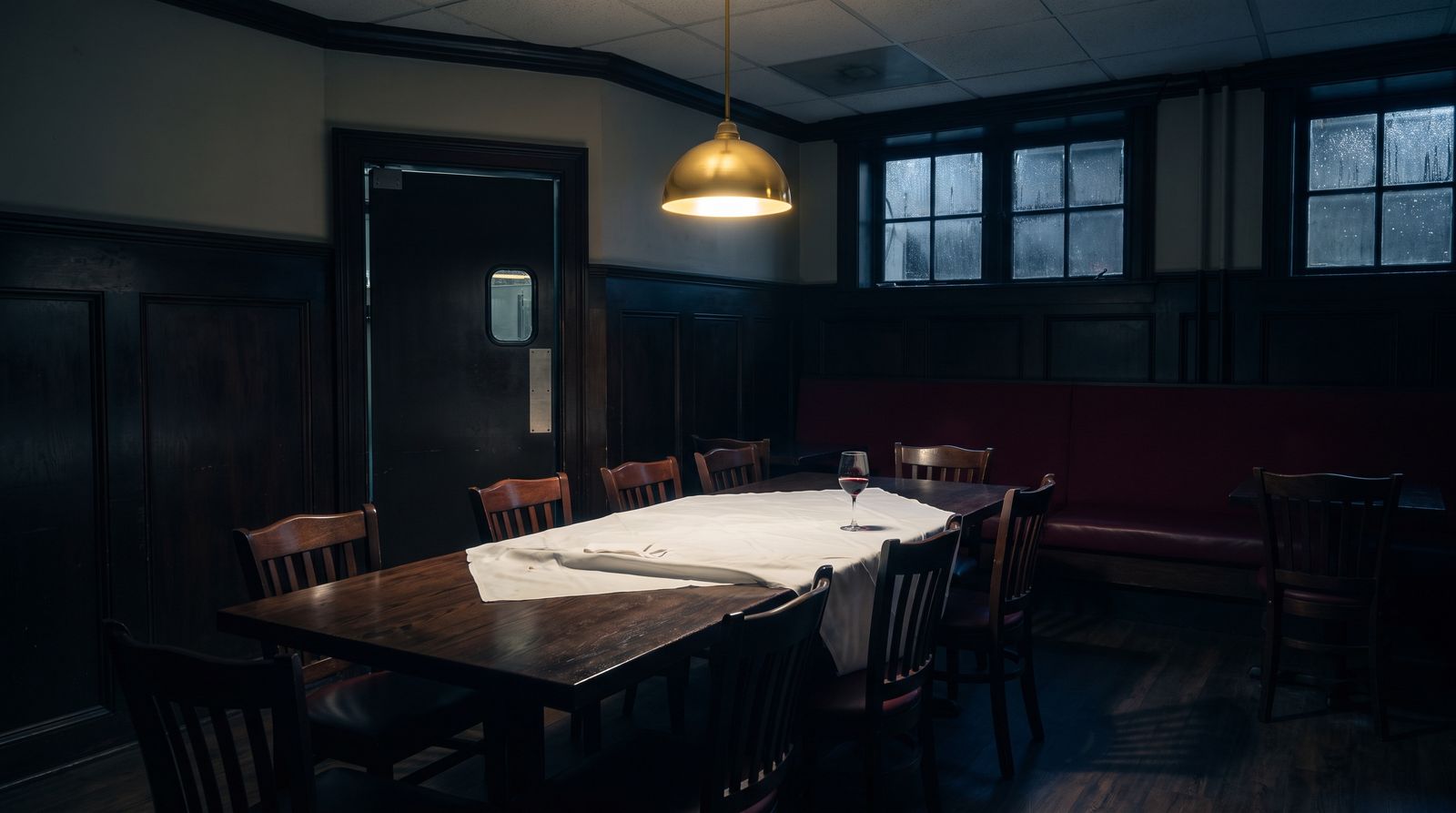
Dante Ravelli was thirty-two years old and he had already started counting the men who would benefit from his father’s blood.
The terrace was wet. Not rain—Stefano’s Chianti, a dark bloom on travertine that would photograph badly and clean worse. Stefano himself was on his back with his mouth open as if he had been about to give an order. The hole in his shirt was small. The hole it made in the North End was not.
Friday, 2 October. Night. The Seaport lights pretended the harbor was honest.
Dante did not kneel. Kneeling was for churches and executions. He stood over the don and listened to the city continue, which was the first insult. A siren too far south. A boat horn from a slip that still moved product under three shell companies Matteo hated on paper. Wind off the channel that smelled like low tide and diesel and the kind of money that never went in a register. Ciro Bellini’s shoes on the stone, too fast, then too careful.
The party had been a small one. Stefano’s idea of intimate: twelve men, two wives who knew how to look at their plates, a catering staff from a North End kitchen that had been feeding Ravellis since Dante was tall enough to steal bread. The secondo had gone out. The wine had been poured. Dante had been in the study with a port schedule when the shot happened, which was either luck or design, and he was already putting luck in the column that did not get to vote.
He had come out onto the terrace and the first thing he had done was not check a pulse. The first thing he had done was look at the angle.
Building across. Third-floor dark. A shooter would have loved that window. The rail was low enough for a man to lean and talk and die. The Chianti glass was on its side, still rolling a little, as if the terrace had not understood it was supposed to stop. Stefano’s hand was curled around nothing. No gun. Stefano had not been expecting a gun. That was information. Stefano had expected to finish a sentence.
“I was in the stairwell,” Ciro said. Forty-five, loyal as a ledger, blood on his cuff that might have been helpful. “I heard it. I didn’t see a face. Miami, Dante. It has to be Miami.”
Dante looked at the cuff. Looked at the terrace wall. Looked at the building across again, the one with the dark third floor and the fire escape that a tourist would call charming. Looked at his father’s mouth, still trying to give an order no one would take.
“Call Matteo,” Dante said. “Not the police first. Matteo, then Chiara, then Nico if you can find him without making a scene. Rafael doesn’t get a call until morning. He left. He can keep the morning.”
Ciro nodded like a man who wanted to be useful. “The port deal—”
“Is why he’s dead or why they wanted him dead. Those are different sentences.” Dante’s voice stayed flat. He had practiced flat since he was twenty and Stefano had put a gun in his hand and called it inheritance. “You don’t talk Miami in the hall where the catering staff can hear you. You talk it to me.”
“I wouldn’t—”
“You already did.”
Ciro’s mouth shut. That was the first smart thing he had done since the stairwell.
Dante went to the rail. Below, the Seaport was doing what the Seaport did after ten: valet lights, a restaurant laughing too loud, a water taxi cutting a white line toward the airport side. East Boston sat across the channel like a second city that had never agreed to be pretty. Vito D’Amato’s water. Sienna’s water, if you counted the clean businesses and the club that paid its taxes loud enough to hide the rest. Dante had sat across from her at two dinners in five years. He put her in a column without meaning to. He took her out again. A dead don did not get to want a woman he had never asked a real question.
He was acting don until the family said otherwise, which meant he was acting don now, because funerals were theater and the port did not pause for theater. He was also a son, which he would deal with when there was less blood on the stone.
He thought in lists. Who wanted the route. Who smiled at dinner last week. Who had been late. Who had been early. Who had asked Stefano about the winter schedule in a voice that was too casual. Miami wanted the port; that was weather. Weather did not usually come with a single clean hole and a lieutenant already naming it.
The catering captain was in the doorway, white-faced, a tray still in his hands like the night could be saved by service. Dante did not raise his voice.
“You didn’t see a terrace,” Dante said. “You saw a man fall. Heart. You will say heart if anyone in a uniform asks you before Matteo’s people ask you. You will take your staff down the service stairs. You will not take photographs. If I hear a photograph existed, I will find the phone, and then I will find the person who thought a phone was a good idea.”
The captain nodded so hard the glasses chimed. He left. He would talk later, in a kitchen, to a cousin. That was Boston. Dante would have Matteo’s people in that kitchen before the cousin finished the story.
Ciro had not left the rail. Helpful. Still.
“The guests,” Ciro said. “Two of them are still in the dining room. The Morelli brothers. They were talking trucking when it happened. I can sit with them.”
“You can keep them in the dining room and you can keep your mouth on heart until Matteo walks in.” Dante turned. “How did you get blood on the cuff if you were in the stairwell.”
Ciro looked at his own wrist as if the question had invented the stain. “I came out. I went to him. I thought—Dante, I thought I could stop it. There was nothing to stop. I put my hand down. I shouldn’t have. I’m sorry.”
It was a good answer. It had the shape of a man who had loved Stefano for twenty years and had put his hand in Chianti and grief. Dante filed it next to the stairwell and did not let the file close.
“Stay,” Dante said. “If Miami did this, they will try the docks before the flowers arrive. If they didn’t, I want the man who thinks I am stupid enough to believe a stairwell.”
Ciro put a hand over his heart. “I would die for this family.”
“Everyone says that,” Dante said, “until they don’t.”
He took out his phone and did not call the police. He called Matteo, who answered on the first ring because Matteo always did.
“The terrace,” Dante said. “Now. Don’t bring anyone who needs a story.”
A pause. Matteo was thirty-one and he had spent a decade trying to make the family look like a company. He would already be standing. He would already be hating the law of what came next.
“Is he gone,” Matteo said. Not what happened. Matteo did not waste a first question on theater.
“He’s gone. One hole. Chianti. Ciro was in the stairwell. Ciro says Miami.”
“Ciro always says Miami when he doesn’t want to say something else.” Matteo’s voice stayed dry, which was how Matteo did grief. “I’m twenty minutes. Chiara’s with me. She was at the office. Don’t let the staff leave with their phones. Don’t let Ciro write the first sentence. And Dante—if you are standing over him counting, that is fine. If you are standing over him becoming him, wait until I get there to do it in front of a witness.”
Dante almost hung up on his brother for that. He did not, because Matteo was not wrong, and because the second insult of the night was that Stefano would have liked the sentence.
“Just come,” Dante said.
He hung up. He texted Nico himself, two words, no punctuation, because Nico did not read paragraphs when the house was wrong: Terrace. Now.
Nico had been in the house last night. Nico heard things. Dante filed that without affection. Affection got people killed. Information kept the rest breathing.
Chiara would already be running numbers in her head. What came next, if Miami was even half of the truth, was a truce that looked like a wedding.
Sienna D’Amato. Twenty-eight. She ran Vito’s clean businesses with a mouth that had never once performed sweetness for Dante’s benefit. The first dinner had been at a North End place Stefano liked because the owner still stood when a Ravelli walked in. Sienna had ordered the fish and asked Dante, across the bread, whether the Seaport front was as clean as the paperwork claimed. He had said clean enough. She had looked at him like a merger she intended to survive. The second dinner had been Vito’s idea of a peace that was not peace, East Boston, a table too small, Roman not there yet because Roman had still been a Miami problem and not a Boston one. Dante had drunk espresso like it was a decision. She had watched him do it. He had not asked her a real question then, either.
He did not want a wife.
He wanted his father to sit up and call him soft for standing here counting.
Stefano did not sit up.
Dante left the rail and walked the terrace the way he walked a slip: edges first, then the middle, then the thing people wanted you to look at. The thing people wanted him to look at was the body. He looked at the planter instead, the one Stefano had insisted on because a don’s terrace should look like a man had taste. Dirt undisturbed. No second pair of shoes in the soil. The shot had come from out, not from a guest stepping onto the stone with a gun in a napkin. Professional. Or someone who wanted professional. Those were different sentences too.
Inside, the dining room had gone quiet in the way rooms went quiet when the money realized it might be next. The Morelli brothers sat with their hands on the tablecloth, visible, which was either manners or fear. Dante stood in the doorway and did not sit because sitting felt like Stefano.
“You were talking trucking,” Dante said.
The older Morelli swallowed. “Winter routes. Your father wanted the inland piece tighter. We said yes. We always say yes.”
“You will say yes to Matteo in twenty minutes and you will not say terrace to anyone who buys you a drink. You will go home. You will sleep. If I hear you slept near a reporter, I will remember the inland piece differently.”
They left through the front, which was stupid, and Ciro redirected them through the service hall, which was smart, and Dante watched Ciro be smart and did not thank him.
The study still smelled like Stefano’s cigars and the lemon oil the housekeeper used on the desk. Dante stood in it long enough to open the top drawer. Port schedules. A fountain pen. A scrap of paper with a number that was a slip, not a phone. No letter. No confession. Stefano had not been a man who wrote down the thing that would get him killed. Stefano had been a man who said the thing out loud to the person in the room and expected the room to hold.
Stefano and Ciro had been in this study. Dante put his palm on the desk and did not punch it, because punching furniture was Gio’s age and Dante was thirty-two and the city did not care about his hands.
His phone buzzed. Chiara: Twelve minutes. Don’t let anyone move him for a photograph. I need the angle. I need the guest list. I need you not to be a son until the numbers are in a column.
He wrote back: I’m not a son tonight.
Chiara: Liar. Be a don who is also a son. That’s the job. I’m bringing the draft language for a joint statement. You are not going to like who it names.
He knew who it would name. He had known since the second dinner. Vito D’Amato would want a picture that looked like a family. Miami would want a picture that looked like a war. The only picture that bought the cousins under twenty-five a year of homework instead of a trunk was a wedding.
He wanted the route held. He wanted Nico in a room. He wanted Rafael to stay in whatever parish or ruin he had chosen and not come home to perform forgiveness over a hole. He wanted Chiara’s numbers to be kinder than they would be. He wanted Matteo to find a law that was not a marriage.
He wanted his father to sit up.
The elevator chimed. Matteo first, coat still on, the face he wore in courtrooms that were not courtrooms. Chiara behind him with a laptop already open and a coat that had not been chosen for a death. She was twenty-eight and she did not perform grief. She walked onto the terrace, looked at Stefano, looked at the building across, and said, “Third floor. I’ll have Gio sit on it without sitting on it. If we kick the door tonight we look like we know too much. If we don’t, we look like we know nothing. I’m scoring us a nothing until dawn.”
Matteo crouched. Matteo did kneel, because Matteo still believed some rooms required it. He did not touch the body. He looked at the hole, the glass, the cuff Ciro was trying not to hide.
“Police in an hour,” Matteo said. “I can make it a heart long enough for us to own the first hour. After that it is a shooting and we are a family with a terrace. Dante. You need to decide if you are going to be the man who talks to the city or the man who talks to Vito. You cannot be both before Monday.”
“Vito,” Dante said. “The city can have a mass if the archdiocese wants to feel included. Vito can have a sentence tomorrow. If Miami is the weather, we need a roof that looks like a wedding. If Miami is a story someone handed us, we still need the roof, because the cousins on both sides are still breathing and I am not starting a war with homework in it.”
Chiara’s mouth ticked. “Sienna.”
“Sienna,” Dante said.
He did not say the rest. He did not say she looked at me like a merger. He did not say I have thought about her mouth twice in five years and both times I put it in a column called later. He said, “Contract tomorrow. You write it. Matteo hates it. I sign it. She will not melt. I don’t need her melted. I need her alive and inconvenient to anyone who thinks a hole in Stefano is an invitation.”
Ciro, from the doorway, helpful: “I can reach Vito tonight. I can set the table.”
“You can reach no one,” Dante said. “Chiara reaches Vito. You reach the docks. If a box lands before the flowers, I want a photograph, not a speech.”
Ciro nodded and did not go. Dante watched him not go and did not send him, because sending him out would have been a tell and Dante did not have the sentence yet, only the count.
Chiara closed the laptop on her palm. “Nico isn’t answering. That’s either docks or a woman or a mood. I’ll find him. Rafael gets a priest’s morning, as you said. Gio is already moving without being told, which I will yell about later. You. You need to wash your hands before the police see Chianti and decide you are a story.”
Dante looked at his hands. They were clean. That felt like a failure.
He went back to the rail one more time. The harbor lights had not changed. The water taxi was gone. East Boston still sat there, a dark stitch of streets and Logan’s stain on the clouds. Somewhere on that side, Sienna D’Amato was going to hear this from her father, which was a kind of intimacy Dante would not have wished on her. He put her age in his head again—twenty-eight—because the contract would need ages and because he needed her to be a person and not a clause before Matteo put her in a packet.
He was thirty-two. He had a dead father on stone. He had a lieutenant who said Miami like a prayer. He had brothers and a sister and a cousin and a city that would wake up tomorrow and want a name.
He left his father on the stone because the living were about to become a problem, and the city did not care that the last Ravelli don had died with his mouth open, still trying to give an order no one would take.
In the hall he stopped long enough to look at the family photographs Stefano had allowed: a wedding that was not this one, a First Communion that was Nico’s, a table in Naples Dante barely remembered. He did not take a photograph down. He did not smash glass. He walked past them like inventory.
Matteo caught his elbow. “You all right.”
“No.”
“Good. If you said yes I would have had you sit down.” Matteo’s mouth was a thin line. “I’ll handle the uniforms. You handle the morning. And Dante—when you talk to her, don’t lead with the port. She already knows the port. Lead with the cousins. That’s the only sentence a D’Amato woman is going to let you finish.”
Dante nodded once. He went to the kitchen, ran the water, washed hands that were already clean, and watched the Chianti-colored rinse that was not Chianti go down. Then he stood in the dark kitchen of a Seaport penthouse that had always been Stefano’s idea of quiet money, and he let himself be a son for the length of one breath.
He put the breath away.
He started the list again from the top.
Who benefits.
Who smiles.
Who was in the stairwell.
Who would marry him in thirty days because the alternative was a city on fire and children in a speech.
He wrote Sienna in the last column, not as a want, not yet, only as a fact that had a pulse, and he hated that he already knew how she took her coffee from a dinner two years ago, and he hated more that he was going to use that fact like a kindness, and kindness, in this family, had always been a kind of threat.
Gio came in through the service door without knocking, twenty-seven, street captain, a cousin who had already decided the night was a job. He had a Saints cap in his hand that was not his and a look that said he had been on the block before Matteo’s twenty minutes were up.
“Third floor across,” Dante said. “Sit on it. Don’t kick it. If you kick it tonight we look like we know too much.”
“I don’t kick what you don’t name.” Gio glanced at the kitchen dark, at the clean hands, at the fact of no son on the terrace. “Nico was on Hanover an hour ago. A bar that still thinks it’s a secret. I can get him without a scene.”
“Get him. If he has a split lip I want the lip before the story. If he has a sentence I want it in this kitchen, not in a bar.”
Gio nodded once and was gone. Dante stood with the list still open in his head and the water still running, and he shut the tap, and he did not go back to the terrace, because the living had already started arriving, and the dead did not need him to watch the stone dry.
Ciro found him in the kitchen with a tray.
Helpful. Always. Glasses that no one had asked for, a cloth over his arm like a man who had decided grief was a service door. Forty-five. The cuff had a dark spot Dante had already filed and had not yet named.
“The North End will come up,” Ciro said. “I can keep the stairwell clear. I can talk to the slips. I can tell them you said Miami if you want the slips to hear a throat. Stefano would have wanted a throat tonight.”
“Stefano is on a slab.” Dante did not take a glass. “You keep the stairwell if I tell you to keep the stairwell. You don’t tell the slips I said a name I have not given you. If Nico has a sentence I want it in this kitchen. If you have a sentence I want it tomorrow, in daylight, when I can look at your cuff.”
Ciro’s mouth did the right things. Grief. Loyalty. The correct amount of let me. “Always, Dante.”
Always.
Chiara caught him at the study door before the living finished arriving.
“Release the first statement at dawn,” she said. “Hold the second until she stands. If you do a son twice this week I will revoke the statement and I will mean it. Nico is a bar. Gio is going. Ciro is a tray. I’m scoring us a nothing until the stone is dry. Don’t go back out there. The dead don’t need an audience. The living need a company face.”
“I’m not going back out.”
“Good.” She looked at his hands. Clean. Too clean. “She’s going to walk in on Saturday and staff you. That’s inconvenient. Stefano liked furniture. You’re going to have to like a woman who asks for lobby names. Don’t confuse that with a feeling until you can afford one. Eat something that isn’t a count. I’m not going to stop.”
He did not eat. He sat in the study with Stefano’s slip scrap still crooked in the drawer and Sienna’s name in a column that was not yet want, and he listened to the living arrive, and he did not pour, and he did not smile, and he let Chiara have the statement, and Friday night became Saturday’s table whether he slept or not.