Chapter one
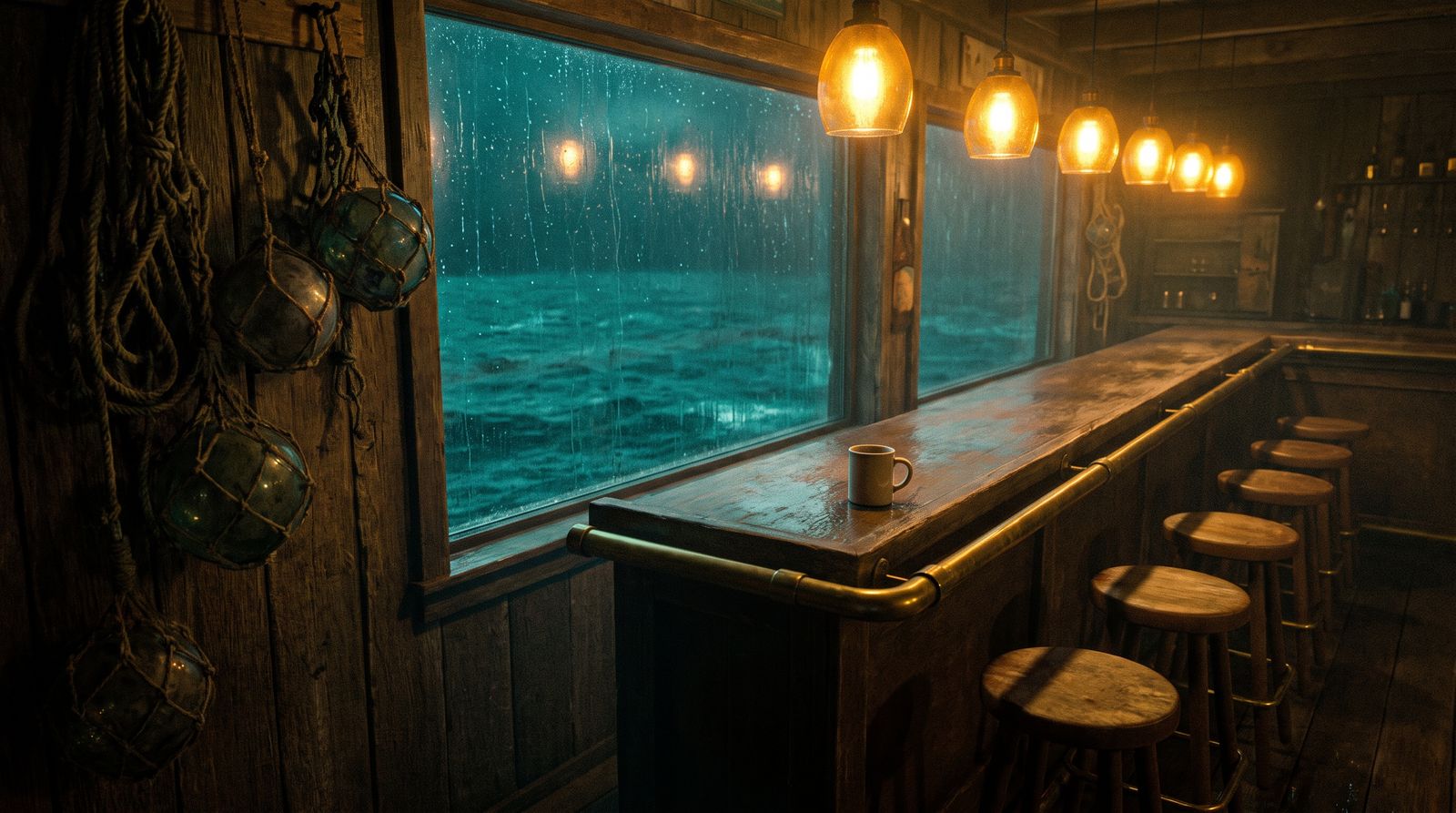
Willa Crowe was thirty-five years old and she had already decided that a funeral and a paper were not the same as coming home.
She had decided it in the car, on the last curve before the bay showed itself, with Roy’s pens rattling in the passenger footwell and a Portland job offer sitting in her email like a polite threat. The highway had given her the usual last-ten-miles inventory: the turnout where she had once changed a tire in a dress; the billboard that still advertised a fish house that had closed in 2018; the sign that said WRECKER’S BAY and meant it, population something small enough to put on wood and not update. She had taken the inside lane. She was not a tourist. She also was not, by any honest definition, a local anymore, and the gap between those two facts was the job.
She had decided it again in the lot behind the Split Hull, when she cut the engine and did not immediately get out, because getting out would make the decision a body instead of a sentence. The lot was the same cracked gravel. Owen’s truck was in its usual lie, parked like a man who believed cones were a conversation. A salt-eaten Honda she thought might be Beckett’s sat nose-out, ready for a departure he never took. Cal’s truck was there too—dark, dented, the marina sticker in the window current, the passenger seat empty the way it had been empty since she left. She sat with both hands on the wheel until the wheel got warm.
She had decided it a third time on the gravel, looking at the back door Owen still painted the same tired green, and then she had gone in anyway, because the Bay Weekly still had her uncle’s name on the masthead and a town this size did not hold a paper open out of sentiment. It held a paper open until someone with a spine sat down, or until Pell & Associates bought the slips and the masthead became a lifestyle insert with better fonts.
The Split Hull still smelled like fryer and rain.
She stood just inside the door with the travel coat still zipped and took the room the way she had been trained to take a room: exits, faces, the story that wanted to print itself before anyone opened a mouth.
Owen Keene was behind the bar. Thirty-two, handsome in the specific way that made tourists overtip and locals forgive him for it, wiping a glass that was already clean. He saw her and his whole face did a complicated thing—fond, then warning, then fond again, like he had rehearsed a joke and then remembered the audience included a man who would not laugh.
Cal Briggs, thirty-nine, captain who stayed, sat with a soda he was not enjoying and a hand too tight on the glass.
Six years of silence sat between them like a stool nobody used.
She had left at twenty-nine. Editor job. Portland. A version of herself that did not have to watch the jetty and the Pell name and a town that made staying look like a virtue. Cal had stayed. That was the whole fight, recycled, still ugly, still true. He had more salt at the temples. He had the same mouth. He had a jacket that had been a jacket in 2020 and had only become more itself. He looked at her the way a man looked at a swell he had already named on the radio: locate, assess, do not pretend surprise.
Willa took a stool as far from him as the wood allowed.
Owen’s voice dropped, fond and warning. “Willa Crowe. If it isn’t the paper, come home to haunt us.”
“I need a room and a week of the archives,” she said, to Owen, not to Cal. “And for no one to make a speech.”
She heard herself: room, archives, no speech. It was a lede. It was also a hide. She had a captain eight stools away and she was talking to a bartender about a CMS. That was professionalism. That was also a woman who had decided in the car that a funeral and a paper were not the same as coming home and was now testing the decision in a bar that smelled like fryer.
Cal said nothing.
The bar did the rest of the talking for a few seconds. A fryer basket lifted. A spoon hit a bowl. Beckett Reed, two stools down from Cal and not looking at anyone, lifted two fingers off the wood in a greeting that might have been for her and might have been for the concept of a door. Thirty-six, veteran, last-call furniture. Willa had known him when he still used more words. She did not make him use one now.
Jude Harlan’s knee was against Tessa Quinn’s under the bar. Settled. Not Willa’s paragraph. Good. She was full of other people’s paragraphs.
Tessa had the kind of face that belonged on a season: open, working, a notebook near the eggs like the eggs might confess. Jude had the kind of face that belonged on a repair ticket. He had not been a man who sat this close to anyone in public when Willa left. He was sitting that close now. His flannel was under Tessa’s jacket in a way that said laundry more than display. Willa clocked it, filed it, and refused to write it even in her head as a feature.
Uncle Roy was in a box in Newport because Roy had always preferred a town that sold postcards. The graveside had been Thursday: wet grass, a minister who had never read the Bay Weekly, and Willa’s mother on speaker from Tucson saying don’t let the paper die, baby, he loved that ugly masthead. Willa had hung up and driven the coast with a box of Roy’s pens in the passenger footwell. Friday she had sat in a motel outside Lincoln City with the hard drive on the desk and Roy’s last voicemail playing once, just once, because he had called about a comma and a city-council spelling and she had screened it, and now the comma was a ghost with better manners than she had. Saturday she had driven the rest of the way and slept in the car for two hours in a turnout, which was not coming home either. She was here because the Bay Weekly still had his name on the masthead and Pell & Associates still had a sale that would print if someone with a spine didn’t sit on it.
Owen slid her a mug without asking. Black. The good pot, not the one he used to punish tourists.
“You look like a lede that got edited by a funeral,” he said. “ Condolences. Roy spelled my specials wrong for eleven years and I miss him already.”
“He spelled them the way they tasted.”
“That’s a lawsuit.” Owen glanced at Cal and then very carefully did not. “Sharon’s full through the week—festival overflow already, and the festival isn’t even here. Claire at the Widow’s Light is doing the polite version of the same sentence. You can have the room above. Sheets are clean. Drain is a personality.”
“I don’t need a B&B. I need a password to Roy’s CMS and a town that will answer a question without calling it gossip.”
“We don’t have those,” Owen said. “We have chowder.”
He slid a key on a plastic fob that said HULL 2 like a threat. The fob was sticky. The key was a real key, not a card, which Willa found obscurely comforting and then resented for being comforting.
“Coffee’s on me in the morning if you don’t make me referee.”
“I don’t need a referee.”
“You walked in on a Sunday,” Owen said. “In this zip code that’s a vote.”
Tessa Quinn, who had been a van and was now a season, lifted two fingers in a hello that did not ask for a quote. Jude did not lift anything. He looked at Willa the way he looked at weather: locate, assess, decide it was not his leak. Then his mouth did something almost kind.
“Sorry about Roy,” Jude said. “He ran a decent paper. He spelled my name right even when I didn’t deserve it.”
“He spelled everyone right. It was his whole personality.” Willa’s throat went tight and she hated it. “I’m not writing a eulogy. I’m writing the slips.”
Tessa’s eyes warmed. “Good. The slips are the story. The jackets are the weather.”
Cal’s glass clicked on the wood.
Willa wrapped both hands around the mug so she would not look at the click. The coffee was a four, maybe a generous four, which in the Hull was a love letter. She drank it. She did not score it out loud. She was not Tessa, and she was not twenty-nine, and she was not going to perform competence for a man who had once told her that Portland was a city that ate people who knew how to leave.
“You eating?” Owen asked.
“I ate in the car.”
“That’s a crime I can’t cite.” He set a plate of toast anyway, the kind of toast that had been a loaf yesterday and a plan this morning. “Roy’s storefront’s still got his name on the glass. I lugged a stack of back issues upstairs because I’m nosy and because the drain needed an audience. Don’t thank me. Thank me by not making this bar a press conference.”
“I don’t hold press conferences in bars.”
“You held one in 2019 about the jetty repair bid and I still have the stain.”
Willa almost smiled. The almost was for Roy, who had stood on a chair to take a photo of a pothole and called it accountability. She did not give Owen the full smile. She did not look at Cal. She looked at the toast, which was honest, and at Beckett’s profile, which was a closed door with a pulse, and at the extra stack of last week’s Weekly by the register, which still had Roy’s column about a missing cat and a harbor-commission typo. The cat had been found. The typo had not.
“I need the CMS,” she said. “And whoever has been answering the phone.”
“Pepper’s niece sat the desk two afternoons because she needed community-service hours and Roy paid her in peppermints.” Owen’s mouth went sideways. “The phone is a landline. It rings. Sometimes I hear it from here and I pretend I don’t, because I am not the paper and I have a fryer. Holt has a packet if you’re doing the marina. He will not like being a source. He will like being accurate more.”
“Holt I can do.”
“Cal you can also do,” Owen said, very mild, “or not. I’m not your mother. Your mother called me from Tucson yesterday and asked if I still had the good whiskey. I lied.”
“She’s not coming.”
“I know. I told her the room was a personality and the town was too. She said don’t let the paper die and I said I pour beer, Linda, and she hung up on me, which I deserved.”
Willa ate the toast standing, one hip against the bar, because sitting would have meant choosing a distance from Cal in inches, and inches were a language they had always been too fluent in. The travel coat was too warm. Portland still lived in the lining: printer toner, rain that came from a river instead of an ocean, the particular soap of a newsroom bathroom. She unzipped it. She did not take it off. Taking it off would have been a paragraph.
Jude said something quiet to Tessa about a ladle and a committee and Tessa stole a corner of his hash browns like a woman who had already been told she could. Their voices stayed in their own weather. Willa was grateful and slightly sick with it. In 2020 she had wanted this bar to be a place a person could leave without it becoming a morality play. It had become one anyway. She had written the leaving in her own head so many times it had a slug: LOCAL EDITOR TAKES CITY JOB, TOWN UNSURPRISED.
Cal still had not spoken.
She could have made him. She had been good at that at twenty-nine: a question with a hook, a silence she refused to fill, the particular cruelty of a woman who knew where a man kept his pride. She was thirty-five and she had a box of pens and a hard drive and a sale that would not wait for her to win an old argument. She finished the coffee.
“Key,” she said, and Owen pointed at the fob already in her hand like she was a person who needed a caption.
“Stairs behind the kegs. Second door. If the sash sticks, lift and swear. If you hear the bar after midnight, that’s not a haunting, that’s Beckett’s last call and my inability to go home.”
“I remember the stairs.”
“I know you do,” Owen said, and this time he did look at Cal, one second, then away. “Welcome to the week, Crowe. Don’t make me mop feelings. The mop is for beer.”
Willa took the key and did not look at Cal again until she was on the stairs.
Then she looked.
He was still watching the glass.
She thought, unkind and accurate: You stayed. I left. We both think we won.
The room above the Hull listed to the west the way everything in Wrecker's Bay listed toward water.
One bed. A window that looked at the alley and a slice of nickel bay. A desk Roy might have loved: scarred, honest, already holding a stack of back issues Owen had lugged up like a dare. The sheets were, as advertised, clean. The pillow had the institutional smell of a washing machine that had opinions about bleach. The bathroom was a converted closet with a shower the size of a threat and a drain that gurgled once, politely, as if to introduce itself.
Willa sat on the mattress and took off the travel coat. Portland still lived in the lining.
The offer was from a vertical that called itself a newsroom and paid like one: benefits, a desk that did not list, a managing editor who had written take the time you need and meant take six weeks and then be useful. Willa had not answered. Answering would have been a nut graf she was not ready to write. She had forwarded Roy’s death notice to the managing editor with one line—uncle, paper, season—and the woman had written back of course, which was the city being kind in a way that still assumed Willa would return.
Willa unpacked the pens.
Roy had believed in pens the way other men believed in radios. He had bought them in boxes of forty-eight from a catalog that still used the word stationery like it was a moral position. Blue. Medium. The caps chewed. She lined them up on the desk in two rows and then ruined the rows because she was not going to turn grief into a display. She left two on the desk and the rest in the box, because a full display was a caption, and she was casing a house she used to live in, not curating one. She unpacked the hard drive. It was labeled in Roy’s block print: WEEKLY / DON’T DROP / FOLIO KNOWS. Folio had been the dog. Folio had been dead for three years and Roy had still used the name as if passwords were a form of loyalty.
The voicemail was still on the phone because she had never been able to make her thumb do the thing that deleted it.
She had played it once in a motel outside Lincoln City and told herself once was the arrangement, and once had turned out to be a lie the size of a Friday.
She had screened it. That was the whole fact and she had been carrying it up a coast for two days. She had been in a room about a food hall, in a building with a view of a river, and his name had come up on the screen, and she had turned the phone face down and thought Sunday. She had called on Sunday. He had not picked up on Sunday.
She played it standing, because sitting for Roy would have felt like agreeing that he was a recording.
“It’s Roy. Don’t call back, it’s nothing. It’s a comma.”
Paper, on his end. The dinosaur tower doing its small-appliance thinking.
“Council minutes, page four. They’ve got ‘Voss, harbor master and the commission has tabled.’ No comma after master. So now Holt is the commission and the commission is Holt and a man could sue over less. I’m not correcting it. Correcting the clerk is a two-week friendship problem and I have a limited number of those left. I’m telling you because you are the only living person who will be annoyed at the correct size.”
A pause. A chair. Folio’s collar was on a nail in that office and had been for three years and she knew exactly which nail.
“They’ve also spelled Szymanski with an h. Third time this year. I’ve started a list. It’s a short list. It’s mostly the one name.”
Another pause, longer than a pause about a comma had any business being.
“Anyway. I’ve got a thing at the doctor’s I am not going to make a production about. And there’s a packet coming out of the harbor office that I don’t like the shape of, and I am getting too old to be the only man in this town who reads the middle pages.”
The sound of him deciding not to say the next sentence. She knew that sound. She had inherited it.
“That’s not a job offer. That’s a comma.”
“Right. Folio says hello. Folio’s been dead three years, that’s my joke, you can have it, I don’t want it back.”
“Spell ’em right, kid.”
The click was him missing the button and then finding it.
Willa sat down on the listing bed after all. He had called about a comma because a comma was a thing he was allowed to call about. He had put the packet in the middle of the message, in the middle pages, where he put everything that mattered, and he had said too old out loud to a machine in an empty office, which he would not have said to her face and had therefore said to her exactly.
She did not delete it. She turned the phone face down, which was the same gesture she had made in a room about a food hall, and which meant something different now, and she was not going to write about which.
She did not unpack the photograph at the bottom of the bag: Cal on the Sparrow in 2019, sun in his teeth, her own hand at the edge of the frame because she had been the one holding the camera and she had already been halfway gone.
Six years.
The back issues went from 2024 to last Wednesday. Willa sat on the only chair and read like a person casing a house she used to live in. Harbor-commission minutes, misspelled. A festival-planning notice that treated mid-November like a holiday and a threat. A police blotter that was mostly raccoons and one sincere argument about a generator. Roy’s last column—two inches, the missing cat, the typo—had a joke in it about Holt’s radio voice that Holt had probably hated and not corrected, because correcting Roy had always taken more time than living with him.
Under the stack, Owen had left a sticky note in the handwriting of a man who wrote specials: CMS is a dinosaur. Phone charger in the mug. I stole the good mug back. —O
Willa found the charger. She plugged in the phone she had been rationing since Lincoln City. Messages stacked up in the order of other people’s needs: the managing editor again, milder; her mother, three texts that were the same text; a Portland stringer named Nolan Ives who had once bought her drinks and written sorry about Roy, if you need a hand on the Bay sale I’m fast; two missed calls from a number she recognized as the Weekly landline, which meant Pepper’s niece or a ghost or both.
She did not answer Nolan. She starred the message so she would not pretend she hadn’t seen it. Fast was a word Portland used when it meant I will write the easy villain.
She texted Holt Voss, harbor master, because the paper needed a source who would not perform.
Willa Crowe. Running the Weekly for a season. Need the marina packet. Not a hit piece. The slips.
Three minutes. Holt typed like a radio.
Packet’s public. Office Monday. Shirt optional. Lying isn’t.
She almost smiled. Holt was thirty-eight and had been a competent irritation since she was a reporter who still thought a press badge changed a room. He had not liked her at twenty-nine and he would not like her now, and that was useful. Like was how stories got soft.
She set the phone face down and stood at the window.
The alley was a wet ribbon. The slice of bay was the color of a nickel that had been in a pocket too long. Somewhere down there, slip fourteen held the Sparrow the way a fact held a page. Willa did not need to see the boat to know the lines. She had coiled those lines. She had slept in that bunk when sleeping on a boat had been a personality and not a relapse. She had left a mug with a crack because she had liked the crack, and she would bet the mug was still there, because Cal Briggs did not throw away things that still held coffee.
The bar laugh came up through the floorboards. A fryer basket lifted. A spoon hit a bowl. A stool scraped.
She would have known that scrape in a blackout. The weight of him standing. The particular pause of a man who had decided not to follow a woman up a stairwell and wanted credit for the decision.
Willa put the phone face down harder, which did nothing, and did not go back.
She washed her face in the closet bathroom. The water tasted like pipes and a town that had never fully convinced its infrastructure to be modern. She looked at her own eyes only long enough to confirm she was still a person who could file a story, then stopped, because she was not going to do the thing where a woman in a rented room inventoried her face for a reader. She was thirty-five. She had a bruise on her hip from a suitcase and a funeral and a turnout nap. She had ink on her thumb from Roy’s pens. That was the lede.
On the desk, last Wednesday’s Weekly had a small box about the marina vote: tabled until after the Storm Festival. Mid-November. Booths on the green, the notice said, as if booths were a form of democracy. Willa circled the box. The sale was the story. The festival was weather. She was not here to write a preview with clip art. She was here to write who wanted the slips pretty and who wanted them to keep holding working boats.
She opened her laptop and made a folder called BAY / ROY / DO NOT GET CUTE. She made another called SOURCES. She put Holt in it. She did not put Cal in it. Putting Cal in a folder was how a conflict of interest grew a caption.
Her mother called. Willa let it go to voicemail, then listened, standing, because sitting for Linda Crowe had always felt like agreeing.
Baby. Owen says you’re there. Don’t fight with the captain on the first day, that’s not reporting, that’s a hobby. Roy loved that ugly masthead. I loved Roy. I am not coming unless you tell me I have to, and you won’t, because you’re stubborn like his headlines. Eat something that isn’t toast. Call me when the paper has a pulse. I love you. I am hanging up before I cry on Tucson, Tucson has enough of my crying.
Willa deleted the voicemail so she would not play it again. She ate the second piece of toast she had wrapped in a napkin, which was not what Linda meant and was also what Linda had always meant: survive the hour.
She went down the back stairs at three because she needed the landline number off the storefront and because staying in the listing room was starting to feel like a dare she was losing.
Oak Street on a Sunday in November was a civic shrug. The hardware that was not a chain had a closed sign and a handwritten if you need a bolt, call. Pepper’s place—Neddy’s Rise, the bakery the town treated like a utility—smelled like yeast even from the sidewalk. The Bay Weekly storefront still had ROY CROWE, EDITOR in vinyl letters that had started to peel at the C. The window display was a stack of last issues and a ceramic fish Roy had thought was journalism. Willa unlocked the door with the key Roy had mailed her in 2021 in case, and she had kept it on a ring she pretended was for something else.
The office smelled like toner and peppermints. The peppermints were a food group. The front desk had a dead plant and a sign-in sheet no one had signed since a man named Glen wanted to complain about a headline that had been correct. The CMS terminal was a tower that made a noise like a small appliance considering its options. A corkboard still held a festival-committee flyer from last year, a takeout menu, and a photograph of Folio as a puppy, which was to say a photograph of a dog who had never agreed to be a mascot and had become one anyway. Willa did not turn the tower on. Monday was for passwords and crying. Sunday was for walking the perimeter so the perimeter knew she had come back.
She stood in Roy’s desk well and put her palm on the wood. The wood was sticky in one corner. The chair still had the cushion he had duct-taped in 2018. The inbox tray held three unopened envelopes from the county and a fourth that said PELL & ASSOCIATES in a font that wanted to be trusted. She did not open it. Opening mail on a Sunday was how a person pretended she had already started the job. On the blotter, in his print: Pell packet — Holt — don’t let the jackets write it.
Under that, smaller, a second line she had to tilt her head to read: Briggs won’t like the jacket.
Willa took a picture of the blotter. She did not touch the notes. She opened the file cabinet with the key on Roy’s ring because she was already here and because a paper that died of politeness deserved a worse obituary than Roy’s. Harbor-commission folders. Advertising past-due. A hanging file labeled MARINA / DO NOT LET THEM WRITE THE HEADLINE in the same block print. Inside: clips, a site map with coffee rings, three charter invoices from last spring with Briggs in the paid-to line, and a sticky note in Roy’s print that said Briggs won’t like the jacket. She did not take the invoices. She shut the drawer like the drawer had teeth.
Monday. Holt. Shirt optional. Lying isn’t. She could be a person who found her uncle’s hunches on a Sunday and still wait for the public packet, because process was the only thing that kept a conflict of interest from becoming a personality.
She sat in Roy’s chair for ten minutes after she shut the drawer and did not turn on the dinosaur. Sunday. Perimeter. The landline rang once and stopped. She let it. She opened the county envelopes because they were not Pell and because process on a Sunday was allowed if it was boring. A tax notice. A subscription complaint from a man in Newport who wanted the extra mailed and had not paid. A festival-planning insert that treated mid-November like a holiday and a threat. She put the insert in a folder labeled HOURS ONLY. She put the complaint in a box labeled GLEN-ADJACENT. She put the tax notice on the blotter under don’t let the jackets write it.
She walked the office once more. Closet: Roy’s sweater, mothball and peppermint, too big. She did not take it yet. Monday was for sweaters and crying. The bathroom was a closet that had given up. She ate a peppermint. She locked the door and walked back to the Hull the long way, past Salt & Timber, where a hull sat in straps like a patient and Jude’s sign still said the salt had been eating it. The bay door was cracked. A radio muttered marine weather at a volume for someone who already knew the forecast and wanted to argue with it. She did not stop. Jude had given her a kindness in a bar. She was not going to pay for it with a drop-in.
At the marina fence she stopped because her feet were stupid.
Slip fourteen. The Sparrow rode the water like a sentence that had already been copyedited. White hull, the name in letters Cal had repainted himself, a little crooked on the S, which he had always said was the boat’s personality and she had always said was his. Lines coiled. Fenders where they belonged. No brochure. A working boat that made a living when the weather allowed and sat there like an argument when it didn’t.
Willa put her hands in her coat pockets and did not go down the finger.
She was thirty-five years old and she had already decided that looking at a boat was not the same as boarding one.
Back in the listing room she made a working list because lists were how she did not become a person who sat on a bed and waited for a stool to scrape.
Monday: Holt, packet, shirt optional. CMS. Folio. Don’t cry on the keyboard. Festival hours only. Vote tabled. Print that. Do not print Cal as a mood. Call Linda after the paper has a pulse. Nolan Ives: later. Or never.
She added, smaller, because she was not a liar in her own notebook:
He is still in the bar. I am still a coward about stairs.
The afternoon slid. She sat on the listing bed with the working list and did not add his name to SOURCES. She opened the back issues again, slower, the way she had gone through court files when a lawyer wanted her to be faster than true. Harbor minutes from a March that had argued about a piling. A letter to the editor about a generator that had been sincere and wrong. Roy’s joke about Holt’s radio voice, two inches, the kind of joke Holt had lived with because correcting Roy took more time than living with him. She copied three sentences she might steal if she started to sound like a food hall. She did not copy the cat column. The cat had been found. She did not need a found cat. She needed a sale that would not wait.
She went down the back stairs at four because she needed air that was not toner and because the listing room had started to list inside her chest. The alley was a wet ribbon. The Hull’s kitchen door was open; Marisol’s pan on the pass, empty, a review. Owen saw her and did not comment, which was a comment. She walked Oak again, the long way, past the hardware’s bolt sign, past Pepper’s yeast, past the café.
The café was the size of a decent lede. Six tables. A counter. A board of rust and civic staples. Lena Myles stapled under rust, Coast Guard contractor, a face that did not suffer fools. Willa did not take the clipping. She took a coffee that was a five if you were kind and a four if you were honest and she sat with her back to the door so she would not inventory every entrance. A woman at the next table talked about festival overflow at the Widow’s Light like overflow was a personality. Willa wrote hours only and left the festival on the board where it belonged.
Sharon from the Tide Rest came in for a crossword pencil and grunted at Willa like a woman filing a person under a masthead. She took the pencil. She did not sit. She said, “Roy’s chair still lists,” and left before Willa could decide if that was condolence or a building inspection. Willa sat with the coffee and the fact that the town was already writing her into a Sunday whether she filed or not.
She walked back. She transcribed Roy’s last three columns into a file so she would have his voice in a format that searched. She found the 2019 jetty-repair piece Owen had mentioned and reread her own sentences from a life when she still thought a byline could keep a town from selling itself. The sentences were fine. The town had not been saved by fine sentences. The town had been saved, if it had been saved, by people like Holt saying no on a radio and people like Rowan Quinn making a hull honest and people like Cal standing at the side of a municipal room watching a jacket the way he watched a reef.
She had not been in that room. She had been in Portland, editing a piece about a food hall, when the vote got tabled. Tessa had sat in the back, if the rumor mill Owen ran with a rag was correct. Jude had said the slips were the reason people stayed in winter. Cal had stood there with his face closed. Willa had read about it in Roy’s two inches and felt, from I-5, the particular anger of a person who had left and therefore did not get to be angry.
She was here now. Anger was a tool if she kept it off the page.
The landline rang. She let the machine take it. Pepper’s niece, bubble letters in her voice: a man named Glen about a headline. Willa did not pick up. Glen had been wrong since a sign-in sheet she had not seen yet and would star tomorrow. Correcting Glen on a Sunday was how a paper died of politeness.
She called the managing editor because six weeks was a courtesy that expired if you treated it like furniture.
“I’m here,” Willa said. “The paper’s real. I need the season, not the sympathy.”
“Take it.” The woman’s keyboard clicked in another time zone that was only an hour off and felt like a different country. “If the marina sale is as ugly as your uncle’s emails, send me the clip. We can use a coastal brief. No pressure. Pressure later.”
“If I send you a clip it will be because it’s true. Not because you have a hole.”
“That’s why I hired you.” A pause. “Willa. Don’t set the place on fire because you’re sad. Sad is allowed. Arson is a different desk.”
“I’m thirty-five. I don’t do arson. I do commas.”
“You do both,” the managing editor said, not unkind, and hung up.
Willa sat with the phone and the ugly truth that Portland still thought it owned her better sentences. Maybe it did. Maybe the Weekly was a season and a debt and a masthead, and then she would go back to a desk that did not list and a city that did not scrape a stool when she walked up stairs. She wrote maybe in the notebook and underlined it once, which was as close as she got to prayer.
At six she went down the front stairs because the back ones smelled like keg and she wanted to be seen as a customer, not a haunting.
The Hull had filled in the way it filled on a Sunday when the weather could not decide: families done with whatever they called church, two tables of men who had been on the water at dawn, a couple in good jackets who were already talking about the festival like it was a destination and not a town trying to pay for itself. Owen moved like a man conducting a small, greasy orchestra. Marisol’s pan on the pass was empty, which in this room was a review.
Cal was gone.
Willa hated that she knew it in one sweep. She hated the small, stupid relief and the smaller disappointment. She took the same far stool. Owen set down a bowl of chowder without commentary. Tessa and Jude’s place was empty; a wet ring on the wood where a glass had been. Beckett had not moved. A woman Willa half-recognized from the Tide Rest—Sharon, smoker’s alto made flesh—sat at the end with last week’s paper and grunted at a crossword.
“He’s on the boat,” Owen said, because Owen was a public utility. “I didn’t tell you that. I’m telling the chowder.”
“I didn’t ask.”
“You asked with your whole face.” He leaned on the bar, voice down. “Roy would have given you one night before he made you write something. I’m giving you the night. Tomorrow you can be a problem. Tonight you’re a woman who buried an uncle and drove a coast. Eat.”
Willa ate. The chowder was a six, maybe a seven if you liked your potatoes to have a point of view. She did not file it. She lived it, which was a sentence she had mocked in other people’s copy and now understood as a way to keep her hands from shaking.
Sharon looked over. “You’re Roy’s.”
“I’m Willa.”
“That’s what I said.” Sharon rattled the paper. “Don’t let the jackets write the marina. Roy wouldn’t. I didn’t like Roy. I respected him. There’s a difference and this town forgets it.”
“I’m writing the slips.”
“Write ’em ugly,” Sharon said, and went back to the crossword.
Beckett did not look up. Owen wiped a ring that was already gone. Willa left money that was too much and Owen pretended not to see it, which was how this bar did kindness.
On the stairs she heard the front door and did not turn. If it was Cal, she would have to be a person. If it wasn’t, she would have to be a person who had hoped. She went up. She locked HULL 2. She sat on the bed that listed and opened the laptop and wrote a lede she hated:
Wrecker's Bay will decide the marina after a festival it has not held yet. The slips will not wait for better fonts.
She deleted it. She wrote:
I am thirty-five and I am not here to haunt a captain.
She deleted that harder.
Coming home was a lede. Staying was the nut graf. She had not written that part yet.
She stood at the listing window and watched the alley go full dark. A truck that might have been his. She put the phone face down harder, which did nothing. She wrote do not print a bunk at the bottom of the working list and underlined it. Looking twice at a 2019 photograph was a hobby. Linda had already banned hobbies that were captains.
The bar laugh came up again, thinner, later. A stool scraped. She would have known that scrape in a blackout. She put the phone face down and did not go back. Owen’s mop would handle the rest. Beckett would handle his own silence. Jude and Tessa were already a season on a shop road. None of that was her graf.
Willa Crowe, thirty-five, editor with a key and a season she had not agreed to, lay on top of the clean sheets in her clothes and listened to a town she had left at twenty-nine pretend it had not noticed her on the stairs.
It had noticed.
She slept anyway, because Monday had a packet and a harbor master who did not lie, and because the drain in the closet bathroom gurgled once more, like a period at the end of a sentence she was not ready to finish.