Chapter one
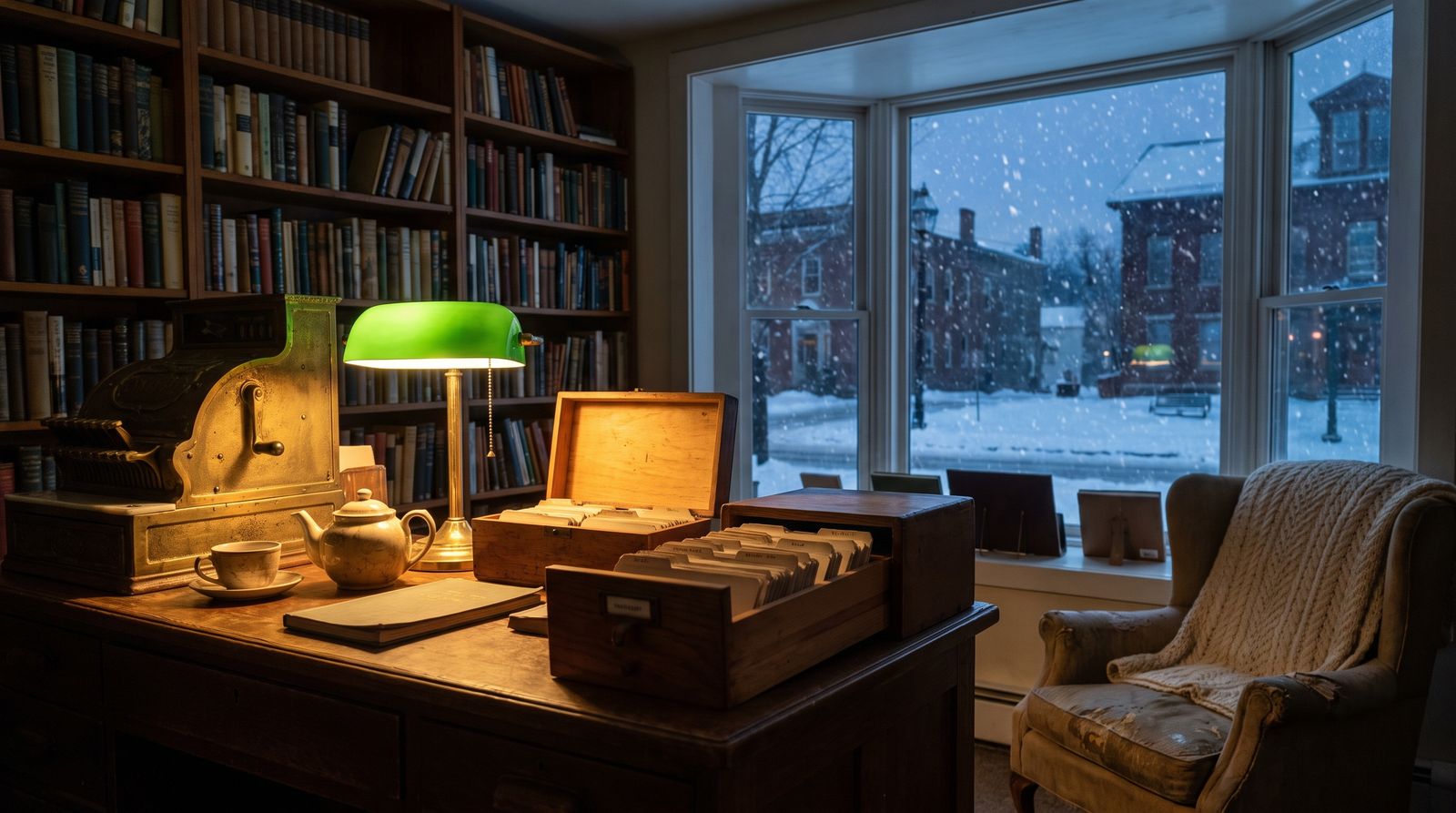
January in Heddleford was a sidewalk that wanted an apology.
Helen Brig was thirty-four and she had come for scones, not a plot. She had unlocked at nine, lift then left, and hung OPEN because Monday hours were Monday hours even when the green was a rectangle of salt and a war memorial that still needed gold. The bakery flyer was still pinned beside Dot’s ribbon. Inventory week. Extra flour. She had pinned it in December and refused to make the pin a prologue. January had arrived anyway, with ice in the boot-tray and a sky the color of a receipt.
Pepper sat on the register and scored the morning. She filled his bowl. She counted the float twice. Honest. She wrote the count on the scrap that had survived the quilt: alive, kettle is a kettle, still no kiss, January is flour. The scrap was not pretty. It was a shop.
The gold lettering stayed. The Fenwick House spine gathered dust on the lower shelf, a silver fox earning rent, no memoir, no Manhattan. She left it. She wiped the brass. She did not alphabetize. The town would come to see if she had learned how. She had not. She had learned to sell paper and to let a sheriff be a habit and to let a cat be a cat.
Molly came at nine-twenty with a cloth and an envelope and snow in the hem of a coat that had been Eleanor’s idea of practical. The jar took the envelope. They did not talk about twenties. They talked about which mysteries had wandered over the holiday and whether the trains wanted their old shelf back.
“Jenna said the diner’s doing leftover pie as a personality now,” Molly said. “Fran said leftover is a typeface. I said shops do leftover. I didn’t say sheriffs.”
“Don’t say sheriffs,” Helen said. “Say paper.”
Molly dusted. Pepper stole tape at nine-forty. Molly photographed him and then looked guilty in the way of a person who still thought a cat on tape needed permission. Helen said a cat on tape was allowed. Molly looked less guilty. Friendship that did not require a speech.
Helen stood at the glass. Sam’s chimney was already a fact. Fran’s card was still a smile for a man named Baines she was not going to solve. The maple had decided on nothing. The sidewalk wanted its apology and was not going to get one from a shopkeeper who had salt on her boots and a flyer that had waited a month to be walked toward.
She sold a cookbook to a woman who wanted gravy and no trouble. She sold a map to a man who wanted the falls and would not walk to them. She told a boy the cat was not for sale and said it louder when he asked a second time. Pepper sat on the holds and did not pose. Helen wrote cookbook, map, staff not for sale and left it.
At ten she put the BACK IN THIRTY card in the window because thirty was a policy and because scones were a better clock than a scanner. Molly had the spare key and a Monday that was her usual Monday. Helen said it would not become a festival. She believed it the way she believed float counts.
The walk was four minutes if you did not stop. She stopped once, at the hardware window, because Tom Goss had a display of ice melt that promised it would not lie, and she did not go in. She stopped again at Fran’s glass, because the smile was still there and she liked to know where it was, and then she crossed to the Oven Door.
Sam Hewitt’s bakery smelled like butter and yeast. The painted board was still honest. The door stuck in the way January doors stuck, and Helen did not rush it. Inside: heat, a bell that had learned not to be dramatic, a case that was doing inventory week by looking slightly more counted than sold. Sam was thirty-eight, they/them—said once as they handed her change, then just Sam—and they had flour on a cheek like a mood.
“Inventory week,” Sam said. “If a bag looks wrong, I know. That’s not magic. That’s counting.”
“I’m here for scones,” Helen said. “I’m not here to count your bags.”
“Good. Bags are a personality if you let them be.” Sam bagged two cheese and one plain and took her money without making it a kindness. “You look like a shop that remembered to eat. I’m putting that in the day’s column. The other column is flour I can account for.”
Helen took the bag. She did not look at the walk-in. The walk-in was a door in the back with a handle that had been wiped and a strip of tape that said FLOUR / BUTTER / NOT A TOUR. She filed the tape as Sam’s humor and not as a plot. She was learning.
The bakery’s front was stools and a ledge and a chalkboard that had inventory, ask, don’t rearrange in a hand that was not trying to be a typeface. A woman from Waterbury wanted to know if inventory meant a sale. Sam said inventory meant counting. The woman bought a loaf anyway, which was the correct pair of feelings about a bakery in January.
Helen sat on the end stool because standing with a bag in a doorway was how you became a review. She ate the first cheese scone slowly. It was good in the way of butter that had been respected. She did not make a list of the crumb or the chew or the salt. She ate. Sam wiped a tray. The oven timer was a tyrant and then it was quiet.
“Tom’s due,” Sam said, not looking at the back. “Hank’s run. If the count is short I will know before the dolly stops. I’m not saying that as a boast. I’m saying it so you don’t have to watch me watch a bag.”
“I’m not watching bags.”
“You’re watching everything. That’s your shop. This is mine. Different furniture, same disease.” Sam’s mouth almost moved. “Don’t alphabetize my trays.”
“I haven’t alphabetized anything since Boston,” Helen said. “I’m thirty-four. I can skip a habit.”
The back door opened on a dolly and a laugh that was already tired.
Tom Reeve, fifty-one, Hank Solis’s driver, pushed through with three stacked bags and the clipboard he had been dropping on her counter since October. He had snow in the seams of his jacket and the face of a man who had already done two towns and had three to go. He saw Helen and lifted two fingers off the clipboard. She lifted two. That was the briefing. He did not make it a reunion. She did not make it a sequel.
“Brig,” he said. “Flyer still up. I told Sam you’d come if the pin was straight.”
“The pin is straight,” Helen said. “The sidewalk wants an apology.”
“Sidewalks always do in January.” He set the first bag on the pallet Sam had marked with chalk. “Three Towns white, fifty-pound, invoice four-four-one-two. Sam, you want me to wait while you count, or you want me to pretend I have a schedule?”
“Count,” Sam said. “I have a schedule. The schedule is counting.”
Tom waited. He did not improve the pallet. He leaned on the dolly and looked at Helen’s bag as if scones were a route he understood. “Molly said the shop survived leftover. I’m glad. I don’t do leftover. I do boxes.”
“Molly does dust,” Helen said. “The shop does paper. Surviving is a typeface we don’t put on the glass.”
“Good.” He tapped the clipboard. “Hank says inventory week is when bakeries invent shortages. I said Sam doesn’t invent. Hank laughed like a man who likes being the only mill in three towns. I’m not filing the laugh. I’m filing the bags.”
Helen filed the laugh anyway, because she was who she was, and then she filed it again as note it, don’t decorate it. Hank Solis was a name she had on a delivery slip and in the diner’s mouth. Fifty-five if the diner was right. Helpful if the diner was kinder than the diner usually was. She had not come to meet a mill. She had come for scones.
Sam slit the first bag’s corner, looked, nodded, made a mark on a card that was already a card and not a performance. The second bag got the same. The third bag got a longer look because Sam looked at everything longer in January.
“Three,” Sam said. “Stencil’s mine. Mill’s his. Count’s not magic.”
Tom initialed the clipboard. He had a tired laugh left and he used it on the dolly as if the dolly had told a joke. “I’ll be back Thursday if the roads stay a road. If you need a spare bag, you don’t. That’s the point of a count.”
“Don’t bring me a spare unless I ask,” Sam said. “Spares are how inventory becomes a novel.”
“I don’t write novels.” Tom glanced at Helen. “She does, a little. Clipboard’s enough for me. If you need a dolly at the shop, you know a dolly.”
“I know a dolly,” Helen said.
He pushed back out. The door took the cold with it and then gave it back. Sam watched the pallet the way Helen watched a gutter: for the place the argument failed. The argument did not fail. Three bags. Three Towns white. Invoice 4412, which Helen had heard and not written, because she was not inventorying a bakery. She was eating a scone.
She finished the second cheese because cheese had already been a commitment in September and she was not going to start January by becoming precious about dairy. The plain went in the bag for later, for a sink, for a cat who was not allowed currants and would try anyway.
“You’re doing the week,” Helen said.
“I’m doing the week.” Sam wiped the cheek and missed the flour, which was correct. “If a bag looks wrong I will know. Tom would know. Hank would know better, which is a sentence I don’t like saying about a man who likes being only. Only is a mood. Counting is a job.”
Helen stood. She did not walk toward the walk-in. She did not taste the walk-in. She was learning. She lifted two fingers. Sam lifted a floury wrist. That was the whole conversation, and it was better than most.
The sidewalk had not received its apology. She walked it anyway, bag warm against her coat, salt loud under the boot. She passed Fran’s and did not go in. She passed the hardware and did not go in. She unlocked her own door, lift then left, because Molly had locked it when a draft made the OPEN sign tap, and she hung the sign again as if thirty minutes had been thirty minutes.
Molly said, “Jenna asked if inventory was a sale. I said counting. I didn’t say flour.”
“Good,” Helen said. “Flour is Sam’s problem until it isn’t.”
She set the plain scone upstairs on a plate that had been Eleanor’s and came down with crumbs. Molly dusted them. Pepper sat on the crumbs and was moved. He sat on the holds. She let him.
The rest of Monday insisted on being a shop.
Before Dot, the morning stretched the way January mornings stretched when a pin had been walked toward and a walk-in had stayed a door: brass, bell, paper, a cat who scored the float by sitting on it. Helen moved him. She counted again because sitting was not a number. Honest. She sold a hiking map to a couple who wanted the falls and would not walk to them and asked if the bakery did a lunch. She said the bakery did bread and counting and she did paper. They bought the map. They left toward Fran’s, which was the correct pair of feelings about a lunch in January.
A man wanted 1994 and got this year. He argued, mildly, that a shop ought to keep last year’s Vermont if last year’s Vermont had been better. Helen said last year’s Vermont was in a box she had not priced and this year’s was on the shelf. He bought this year. She wrote this year, not last, not a box and left it. A woman wanted a dog that lived and got one, British, train optional. She asked if the cat lived. Helen said the cat was staff and lived here and was not for sale. The woman bought the dog and looked at Pepper as if taking attendance. Pepper did not pose. Helen let that be attendance enough.
She walked the mid room between sales. She reshelved a row that had wandered over the holiday, paperbacks that believed they were alphabet and were not. She left Eleanor’s arguments. She stood at the glass and looked at Sam’s chimney and at the flyer on her own window from the inside, backward, inventory week still inventory week. She did not take the pin down. She turned back. She wiped the brass. She told a tourist the cat was not for sale and said it louder. She sold a garden book with soil in the gutter, honest, priced not pretty. She made tea in the shop kettle and drank it standing up. The tea was only tea. She did not take it into Folio. Folio was cooler. Folio did not need a Monday mug.
She stood in Folio’s doorway anyway, a check, not a pilgrimage. The lintel shouted. The gap was a gap. The owls were ugly. The quarto said DO NOT SHELF. She did not shelf it. She told the room she had come for scones and not a plot and the room had been a woman who liked queues, and the room did not argue. She dusted the runner. She went back to the brass.
Molly said, from the trains, “Tom told Jenna he’d be driving boxes all week. I said boxes are a route. I didn’t say uncle. I’m saying uncle to you because he’s my uncle and you’re a shop that lets me dust. I’m not making it a speech. I’m making it a Monday.”
“Monday is allowed,” Helen said. “Uncles are town fabric. Dust is a job.”
Molly dusted. Pepper stole tape at eleven-five. Molly photographed him. Helen let it be a memorial that did not require a death, which was the correct kind of memorial for a Monday that still had a tired laugh in it.
Dot Sewell came with no minutes and a look that had already had three conversations about leftover fabric that was now leftover leftover.
“Evelyn is putting January in and taking festival out,” Dot said. “I’m letting her. Festivals are a typeface I like in November. January is a typeface I like if it stays bread. You’re doing bread. I’m putting that in the minutes before she can put reluctant.”
“Put present,” Helen said. “I’m thirty-four. I can do present.”
“Present is a typeface I like.” Dot squeezed her wrist, brief, the same squeeze as September. “Doreen says the inn has empty rooms and decent soap if the town gets loud. I’m not making you a guest. I’m making you a sentence. If you need quiet that isn’t a cat, you know a porch.”
“I know a porch,” Helen said. “I’m using a counter.”
“Use a counter.” Dot bought a bookmark she did not need and left before the bookmark could become a toast.
Helen wrote Dot: January, present, porch unused and sold a garden book to Irene Cobb, who said her frame was still in the barn and would stay in the barn until she could look at a pocket without seeing a hyphen. Helen sold her the book. She did not sell her a speech.
At noon Sam’s boy came with the loaf that was not a note, only bread, and a second flyer in case the first pin had failed. The pin had not failed. Helen put the second flyer in the drawer. Two flyers was a novel. She ate over the sink. She came down. She sold a town history to the man from the falls who was still sad and still buying the booster pamphlet. He wanted to know if the mill meeting would be in anyone’s minutes. She said she sold pamphlets, not minutes. He bought the pamphlet anyway. He said Hank Solis liked being the only mill in three towns and maybe a mill could do inventory of a charter. She said that was a later he could take to a selectman. She did not say Baines. She did not say G. She said later. He left with the pamphlet and the later. She wrote falls: pamphlet, mill later, no letter and left it.
She walked the mid room. She reshelved the trains. She left Eleanor’s arguments. She stood in Folio’s doorway and did not fill the gap. The lintel shouted FOLIO in letters someone had gilt a long time ago and then let dull. She left the owls. She left the quarto that said DO NOT SHELF. She told the lintel January was flour and the shop was a shop, and the lintel did not argue.
Patricia Holm called at one and said clocks were how sequels began and she was still not a plot and Croft was still billed and Helen should go sell a book. Helen said she was selling a book. They hung up. Pepper sat on the phone as if billing were a lap. She moved him. He sat on the holds.
Hugh’s cruiser rolled past at one-twenty without hurry. He did not stop. She did not go to the glass to make him stop. She lifted two fingers when he was opposite the maple. He lifted two off the wheel. Tomorrow implied leftover, or coffee, or a doorway. She filed it as habit and went back to the brass.
Lois Brant came with a question about whether the jar was still a jar. Helen said it was. Lois put nothing in it and looked relieved, which was progress. “Dot said January doesn’t get a tin,” Lois said. “I’m not bringing a tin. I’m buying a mystery with no swearing. I’m tired of the paper.”
Helen sold her the mystery. She did not offer a basement. She did not offer a mill. She wrote Lois: jar is a jar, no swearing and wiped the brass again because wiping was how you kept a Monday from inventing a Tuesday too early.
At two she opened Eleanor’s desk book, not to match, to remember. The fussy pencil. The vein that changed its mind. G. asked. said no. folio not for sale. A line she had not needed in December sat lower, in the same coded hand: a quarto, small, missing, a mark that was not a title. She copied nothing. She already had a card for G. and a period. She sat with the missing until the missing was boring, which was how you kept a January from becoming a speech. Then she put the book away. She put her hand on the folder that was LATER and did not open it. LATER had a label and a period and an ice she was not going to make into flour. Book 6 could have a selectman. Book 8 could have a collector. This week could have scones and a count.
The two o’clock hour after the desk book was an hour she gave back to the brass. She sold a mystery with no swearing. She sold a town history to a woman who wanted a boundary and not a mill. She told a tourist the cat was not for sale. She walked the mid room. She reshelved the trains. She left Eleanor’s arguments. She stood at the glass and looked at Sam’s chimney and at the flyer from the inside, backward, and at Fran’s smile, and she turned back. She wiped the brass. She counted the jar. Honest. She made a second tea and did not finish it. She stood in Folio and did not fill the gap. She told the lintel a quarto line was a line and a scone had been paid for and the folio was still not for sale. The lintel did not argue. She left the owls. She left the room’s quarto. She dusted the runner. She went back to the brass and sold a garden book with soil in the gutter. She wrote no swearing, boundary not mill, garden soil, desk book shut and left it.
At two-forty Tom Goss came with a question about whether inventory week would change anyone’s lock. She said she sold paper, not locks. He said that was sensible and bought a map he did not need, which was still the hardware’s idea of a donation that was not a jar. She put the money in the drawer. She wrote Goss: locks not inventory, map, drawer not jar and left it. At two-fifty Molly finished the trains and started the spinner. Pepper sat on a hold. Helen let him. Monday held. She let it.
She sold a cookbook to a man who had forgotten he had guests. She sold a mystery with a dog that lived to a grandmother who asked if the sheriff had a holiday. Helen said the sheriff had a desk. The grandmother said desks were how men missed January and then bought the book anyway. Helen took the money. She did not make January pretty.
Molly finished the mid room a second time because finishing twice was how you kept a Monday from inventing a body. Helen sent her home at three-forty. The green was already thinking about early dark. Sam’s chimney was a fact. Fran’s card was a smile. The bakery flyer was a pin. Helen stood in her own lettering and did not wait for a cruiser that had already been and gone.
The last hour did what last hours did when a pin had been walked toward: it tried to become a prologue. She refused the prologue. She sold a map. She told a tourist the cat was not for sale. She counted the jar. Honest. She stood in Folio and did not fill the gap. She told the lintel she had not tasted a walk-in, and the lintel had been gilt by a woman who liked queues, and the gilt did not argue.
Hugh texted at four-fifty: See you tomorrow. She texted it back. She closed. She locked both locks. She checked the alley from the inside. Empty. She left the fan off. Wood tick. Literacy.
Before she went up she stood in the front with the sign in the drawer and the flyer on the glass and the gold lettering doing what it had done since September: stay. She told the empty room the shop was a shop, which was the point, and Pepper sat on the register as if scoring her, and she took the sit as a pass. She turned off the mid-room lights. She left the front lamp until she was on the stairs, then that too.
Upstairs: photograph straight, Pepper fed, tea in Eleanor’s pot, not a ceremony. The plain scone on the plate. She ate it over the sink and did not make it a list. Notebook:
11 Jan. Scones. Sam counting. They/them once at the change, then Sam. Tom Reeve, fifty-one, dolly, invoice 4412, Three Towns white, tired laugh. Hank likes being only. I did not taste the walk-in. I am learning. G. still a period. Quarto line still a line. See you tomorrow. Still no kiss. Pepper wants the corner and cannot have currants. I am thirty-four. The sidewalk wanted an apology. I sold paper instead.
She did not write an ending. Endings were for manuscripts you could support. The count was supported. The pin had been walked toward. The walk-in had stayed a door.
Helen Brig, thirty-four, alive, a shopkeeper, a woman who could skip a scone in a building and still buy three. She turned off the light. She slept.
Pepper blinked in the dark, or she invented the blink. She decided to take it as a lease.
She had walked toward a pin. She had not inventoried a bakery. She had not kissed a sheriff in a doorway or on a landing. Heat 1, as promised. The shop had stayed a shop. January could earn its flour. She would be here when it did. She would hang OPEN. She would count the float twice. She would tell the cat he was not for sale. She would let Hugh roll past at dusk and lift two fingers, and she would lift two, and she would not rush a lock, and she would not rush a kiss. The kiss could wait for a later book. This one had been enough for a Monday: butter, yeast, a tired laugh, a clipboard, a number she had heard and not needed. She slept on that, and the almost from December stayed on the stairs like wool, and she did not name it, and she did not need to.
Winter, in Heddleford, always had another body in it. She did not say that aloud. She said it to the flyer on the glass, downstairs, pinned, January, extra flour, and the flyer did not file a report.
She would be here when January earned it. She intended the earning to be bread. She intended the walk-in to stay a door she did not taste. She was learning. Learning was a typeface she liked. She slept on the learning without opening it. Opening was Tuesday’s job if Tuesday wanted a job. Monday’s job had been hours. She had done the hours. She let them hold.
She had paid exact for the scones. She had not let the change become a conversation. She had heard 4412 and not written it, because she was not inventorying a bakery. She would need the number later. She did not know that yet. She knew the pin was straight and the bag had been warm and Sam had counted three bags that were bags. She knew Tom Reeve had a tired laugh and a dolly she knew. She knew Hank Solis liked being only. She knew Pepper was a cat. She knew Hugh would roll past at dusk. She knew she would lift two fingers. She knew she would not kiss him. Heat 1, as promised. Monday held. She let it hold. The flyer downstairs did not file a report. The sidewalk did not get its apology. The walk-in stayed a door. She slept on the door, and Pepper took her feet, and the building ticked in wood, and she did not rush the morning she did not yet have.