Chapter one
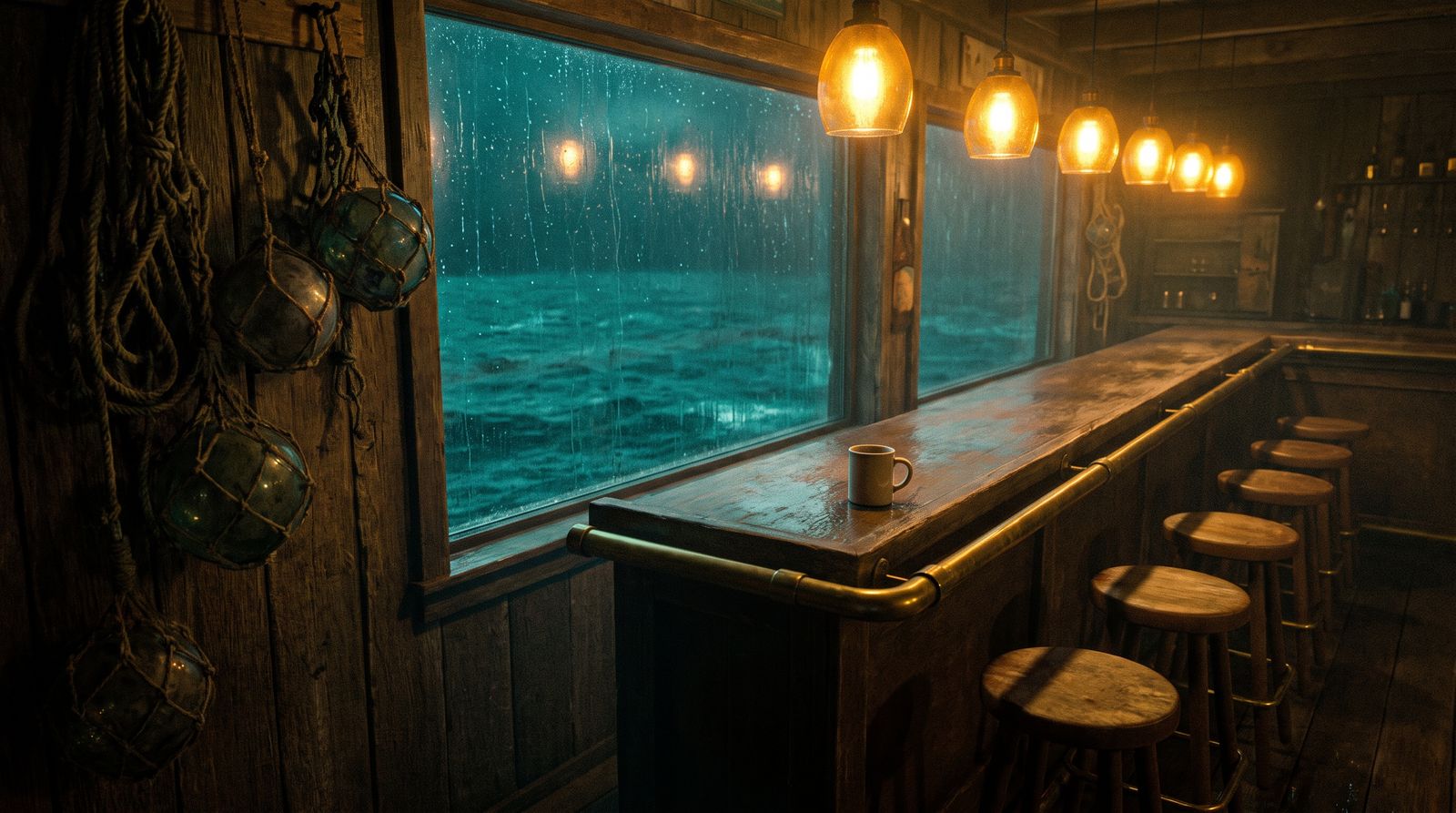
Owen Keene had run the Split Hull for five years and he had a system: lemon oil, last call, do not fall in love with the regular who only looked up when the tray dropped.
Festival week blew a hole in the system.
He was thirty-two, which he had said out loud that morning to the produce guy from Astoria because the produce guy had called him kid and Owen had a policy about being a kid in his own walk-in. Five years of keys. Five years of the specials board and the fryer and the jukebox that only knew six songs. Five years of wiping the bar like the bar might leave if he stopped. He was handsome in a way that made tourists tip too much and tired in a way that did not show on the chalkboard. He poured. He joked. He was sunshine for a living. He did not look at Beckett Reed’s stool until last call made it legal.
Tuesday of festival week, last call was a rumor and the legal was already a joke.
Owen unlocked at ten because festival people believed in brunch the way other people believed in God, and because Marisol Adeyemi had texted at six-forty from a produce lot that the clams were honest and the cream was a crime he was not allowed to commit. He had written do not drown the chowder on the legal pad in letters large enough to be a municipal code. Tessa Quinn had already threatened him once, in October, in the kind of voice that scored soup for a living. She was still in town. She had a season now. She had Jude Harlan’s doorway and his coffee and a ladle assignment Owen had written in Sharpie so Jude could not pretend he hadn’t seen it.
The green already had stakes in it. From the front windows of the Hull the stakes looked like a field of bad decisions: orange flags, a coil of extension cord someone was going to trip on, the first ugly generator squatting near the quilt tables even though the committee—Owen, legal pad, assumption that adults would disappoint him—had said no generators by the quilts. Sharon at the Tide Rest was full. Claire at the Widow’s Light had overflow and a booking system that made Owen’s POS look modern. The pass was doing what the pass did in mid-November, which was sulk and then close and then sulk about being closed.
Owen oiled the bar.
Not the long wipe. Not yet. The morning wipe: lemon, cloth, the dark wood that had been a boat something before it had been a bar, the nick near the service station where a pint glass had died in 2023 and he had never sanded it out because the nick was a story and he liked stories that stayed put.
The nick had a night in it. A tourist who had wanted the Hull to be cuter than Vince had allowed. A pint that had gone over when Owen turned to tell the jukebox to pick a different one of the six. Glass. A groan. Dex had not existed yet; Owen had mopped it himself and left the bite in the wood because sanding it out would have been making the room cute. The tourist had left a twenty and an apology. Owen had put the twenty in the tip jar and the apology in the walk-in and the nick on the list of things he would not fix. Five years of keys. One nick. A stool at the end that he did not look at until last call. The wood remembered. Owen remembered. That was enough memorial for a Tuesday morning. The Hull smelled like itself: fryer, beer, the particular sweetness of wood that had been wet and then not. Outside, the bay was the color of old nickel. The jetty threw a little white. Somewhere past the point the Hester was a myth the town still said accident about, and Owen did not put that on the specials board.
He started coffee. He started the fryer. He wrote TUESDAY on the specials board and then, because festival week made him mean, CHOWDER THAT IS NOT A CRIME. Under that: clam, bacon, bread that Pepper had dropped at dawn from Neddy’s Rise with a note that said do not toast this like a tourist and a they/them doodle of a roll that had opinions.
The back door banged.
Marisol came in with a crate and a face that said the crate had already been judged. Thirty-four, chef pop-up, foil pans that had become a rumor and then a fact. She set the crate on the prep table and looked at Owen’s board.
“That is not a special,” she said. “That is a threat.”
“I contain multitudes.” Owen poured her coffee without asking. Black. No performance. “Runner’s new. Festival hire. Name’s Dex. If he drops a tray, I will not fire him in front of God and Jude Harlan, but I will think about it.”
“Dex is twenty-six and he has never carried soup in a wind,” Marisol said. “I told him the wind is a personality. He nodded like I was being poetic.”
“Oregon is never poetic. Oregon is wet.”
She tasted the coffee, made a face that was almost fond. “Four. You’re being generous with yourself.”
“I’m a six after noon. It’s a medical condition.”
They worked. That was the part tourists never put in the postcard: the Hull before the first stool scraped was a kitchen and a math problem and a man with a legal pad who had decided, at twenty-seven, that a dying bar in a town of four thousand was a better life than Portland tips and a roommate who played the same three songs. Owen had come down the coast with a duffel and a joke and a lease that Holt Voss had called ambitious on the radio, which from Holt was a blessing and a threat. Five years. The lease had become a life. The life had become a system. The system had a stool at the end of the bar that stayed empty until last call most nights, and Owen had a rule about that stool, and the rule was: do not make it a graf.
Beckett Reed. Thirty-six. Veteran. Out two years. Last call most nights. He drank like a man who had decided one glass was a personality and a second was a problem. He did not talk. He lifted two fingers. Optional. Kind.
Owen wanted to put his mouth on the kind.
He did not put that on the legal pad.
Jude Harlan came in at eleven-twenty with sawdust on his cuffs and the face of a man who had been assigned a boat kids’ table and had not forgiven the assignment. Thirty-eight. Contractor. Boat repair. He took the stool that let him see the door, which was not Beckett’s stool, and Owen poured coffee before Jude could pretend he wanted something harder.
“Shirt,” Owen said.
“I own shirts.”
“Holt specified the one that isn’t a cry for help. I wrote it down. I have witnesses. One of them is your girlfriend, and she scores things.”
Jude wrapped his hands around the mug. “She’s on ladle. I’m on kids who think boats are toys. If I smile they will ask for a ride. If I don’t smile they will think boats are punishment. There is no correct face.”
“There is a face that is not your Monday face. Find it by Thursday.” Owen leaned on the bar, sunshine on, professional. “Chowder’s honest. Tessa already threatened the cream. You’re both on the green Thursday through Sunday and if you hide in Salt & Timber I will put your name on the specials board under missing persons who owe me a boom tent.”
“I don’t owe you a boom tent.”
“You owe me a boom tent, two extra tables, and the look you give a hull when the straps are wrong. I can use that look on the generator people.”
Jude drank. His mouth did the almost-kind thing it did when Tessa was in the room and sometimes when she wasn’t. “Hannah’s coming Thursday. She says don’t sell the marina while she’s on the bridge.”
“Vote’s tabled,” Owen said. “Holt said so like a weather warning. Pell can wait until the town is done being drunk on clam and nostalgia. Tell your sister she can file a complaint with the Widow’s Light if Claire gives her a bunk that lists west.”
“She’ll like Claire. She’ll like Tessa. She’ll be annoying about my face.” Jude stood. The stool scraped. “If Reed’s coming in early tonight, don’t make it a project. He moved chairs for the committee. That’s already a speech by his standards.”
Owen did not ask how Jude knew Beckett might come early. Jude looked at leaks. Jude had seen the long wipe. Half the town had seen the long wipe. Willa Crowe had seen it last Sunday and had, blessedly, gone upstairs for a hard drive and then to the ridge without making it a graf.
“I don’t do projects,” Owen said. “I do booths. I do chowder. I do last call.”
“You’re still talking,” Jude said, which was a Beckett line stolen without permission, and then Tessa Quinn came through the door like a woman who had decided the town could have her for a season and was still surprised it had said yes.
Thirty-one. Food writer. Van that was also rent, now parked like it belonged. She kissed Jude at the door—one second, public-adjacent, her shoulder under his hand—and stole his coffee in the same motion. Settled. Not Owen’s paragraph. Good. He was full of other people’s paragraphs.
“The chowder,” Tessa said, already tasting the air. “If you drown it I will write you a one-star in a notebook I will never file, and you will feel it anyway.”
“I would never. I would almost never.” Owen slid her a bowl without writing anything down. “Festival’s Thursday through Sunday. You’re on ladle. He’s on kids. I’m on the legal pad and the crime of fonts. Cal and Willa hung a banner yesterday that looks like a ransom note. I complained. Willa said the Weekly does not do clip art and then she used clip art.”
Tessa tasted. Pause. Breathe. The small nod that was not for the room. “Eight. You listened. The bacon’s still real. I’d take a half point for the oyster crackers, which remain a crime against texture, but I’m on ladle this week so I’m feeling kind.”
“Kindness is a health code,” Owen said. “Don’t spread it. I have a reputation.”
They left together, her knee bumping his as they went, and Owen wiped their place and did not think about wrists.
He thought about wrists anyway.
The lunch crowd was festival-adjacent: Sharon from the Tide Rest with a coffee the size of a threat and a smoker’s alto that said the drain still sucked; a table of quilt women who wanted hot water and opinions about the generator; Holt Voss in the doorway with the radio on low, thirty-eight, harbor master, a man who tabled votes and told people not to park in the slip lane. Holt lifted his chin. Owen lifted a mug. That was a conversation.
Festival Tuesday lunch was not a postcard. It was wet coats and people who wanted to be useful before they were assigned. Sharon wanted the generator moved. The quilt women wanted the generator dead. Holt wanted the slip lane empty. Owen wanted a legal pad that could do three jobs and a regular who was not yet on a stool. He poured. He plated. He told a man from Astoria that the chowder was an eight if he was kind and a municipal code if he asked about hotels. He stole a second of quiet at the well and used it to not look at the empty end of the bar.
“Finger that’s not south is still not south,” Holt said, to the room, which was how Holt talked when he wanted it on the record without a meeting. “Jacket on the green Thursday. He can smile. The vote stays tabled. I’m not stacking a sale on a weekend when the town is selling soup.”
“Bless you,” Owen said. “And also I will charge you for the coffee if you keep standing in my draft.”
Holt paid. Holt always paid. He left a wet rectangle of November on the mat.
Cal Briggs came in at two with Willa Crowe and a soda he seemed, for once, to be enjoying. Cal was thirty-nine, captain, a no the Bay Weekly had printed correctly, and the town had not exploded. Willa was thirty-five, editor who had come back, ink on her thumb, a stack of extra papers under her arm like a dare. They took a booth. Their knees touched. Owen delivered the soda and Willa’s coffee and did not referee, because he had promised himself he was done refereeing other people’s seasons.
“Fonts,” Owen said, because he was not done with the banner.
“The banner is a public service,” Willa said. “If I fix the fonts, tourists will think we have a budget. We have Pepper’s rolls and your threats. That’s the brand.”
Cal’s mouth twitched. “She’s right.”
“You’re both banned from my legal pad.” Owen set down bread. “Booth map’s on the bar if you want to fight about the Weekly table. I put you downwind of the fryer and upwind of the band. That’s as kind as I get.”
Willa took the map. She did not make Owen’s long wipe a graf. He almost liked her for that, which was dangerous, because liking people was how he ended up with a system that had a hole in it.
Pepper came in at two-forty with a second tray of rolls and the look of a person who had already fought a proofing cabinet and won. They set the tray on the pass, tucked a curl behind their ear, and scored Owen’s coffee with a glance that did not need a sip.
“Still a four,” they said. “Don’t put my rolls next to the generator. Steam makes them sad. Sad rolls are a crime I will put on a flyer.”
“I would never. I would almost never.” Owen stole a roll anyway, because ownership was a theory and hunger was a fact. The crumb was honest. The icing had opinions. “You’re an eight. I’m not putting that on the board. You’ll get smug.”
“I contain smugness.” Pepper nodded at the empty stool at the end, not making it a question. “You want extra tomorrow. Festival people eat like the pass is closing. I’ll bake like the pass is closing. You can pay me in the usual and a threat to anyone who calls them rustic.”
“Rustic is banned. I posted it in 2024.”
They left a cinnamon print on the legal pad, which Owen did not wipe off. The Hull ran on grease and paper and people who came back. Pepper came back. Jude came back. Beckett came back at last call and left before the wipe could become a sentence. That was also a kind of coming back. Owen had been living on it for two years like it was a diet.
He took the roll to the walk-in and ate it standing up, cold on his neck, the shelf of cream doing the thing cream did when you had been told not to drown a chowder. He was thirty-two. He had a lease, a fryer, a jukebox with six songs, and a crush that had outlasted two tourist seasons and a marina rumor. He had, at twenty-seven, told a Portland bartender he was going to buy a dying room on the coast and make it a church that served fryer. The Portland bartender had laughed. Owen had not been joking. The dying room had become the Split Hull. The Split Hull had become a system. The system had a hole in it shaped like a man who lifted two fingers.
Owen wiped sugar off his thumb and went back out.
Claire Bennett called from the Widow’s Light at three-ten, which meant the overflow list had grown a personality. Owen wedged the phone against his shoulder and poured a pint with the other hand.
“If you send me one more couple who thinks a storm festival is a spa,” Claire said, forty-two and already tired, “I will send them back with a quilt and a bad review of your fonts.”
“The fonts are Willa’s crime. I’m an accessory.” He rang up the pint. “Hannah Harlan’s coming Thursday. Jude’s sister. She has opinions. If you have a bunk that doesn’t list too far west, she’ll pretend to be grateful and then threaten Pell in your parlor.”
“I have a bunk. I have six bunks. I have a booking system that is a spreadsheet and a prayer.” Claire paused. “You’re doing the green and the bar. That’s two jobs. Eat something that isn’t a roll you stole.”
“I stole it legally. Pepper witnessed.”
“Eat a meal, Keene. I am not hauling you out of your own walk-in mid-festival.” She hung up like a woman who ran an inn and did not have time for his medical conditions.
Owen ate a bowl of his own chowder at the end of the bar, not on Beckett’s stool, because sitting there in daylight felt like trying on someone else’s jacket. The chowder was an eight if you asked Tessa and a seven and a half if you asked him, because he knew where he had gotten generous with the thyme. He ate standing, one eye on Dex, one eye on the green through the front glass. Sharon crossed the stakes with a coffee and a glare for the generator. A kid in a rain jacket planted a flag and then asked Jude a question that made Jude look like he might jump in the bay. Tessa laughed at him from a folding table and did not take a photo. That, Owen thought, was how you could tell she had decided to stay: she was living it instead of filing it.
The afternoon went the way festival Tuesdays went: deliveries that were late, a keg that foamed like it had opinions, Dex the new runner practicing the service station with a stack of empty cups and the concentration of a man defusing something. Owen showed him the corner. The corner was a bastard. The corner had taken two trays in October and a pint in August and Owen’s dignity in a year he did not discuss.
“Wide,” Owen said. “Then turn. If you catch it, the whole room hears you. If the whole room hears you, someone at the end of the bar is going to lock up, and then I am going to be rude to you in a way that is not sunshine.”
Dex nodded. Twenty-six. Festival-hired. A good face and hands that had not learned the Hull yet. “I’ll wide. I’ll turn. I won’t make it a show.”
“You will make it a show once,” Owen said, not unkind. “Everyone does. Just don’t do it at nine-forty when the generators are already coughing.”
He did not say when Beckett is here. He did not have to. The stool at the end was a fact. The town knew the fact. Owen was sunshine. Beckett was last call. The space between them was a wipe that had gotten too long.
Owen went to the basement for napkins and stood in the cold for a count of ten, because the walk-in was quiet and the generators on the green were not, and because he was thirty-two years old and he had a crush that had lasted two years and he was tired of pretending the crush was a health code.
Beckett had come home in a November that was not this one. Two years. A cousin’s couch, then the studio over the hardware that was not a chain and never would be. Dock work when Holt called. Chairs when Owen asked, which Owen had asked for the committee in October, and Beckett had moved them without a speech and left before whiskey. He sat where he could see two exits. Owen had noticed on the third night and had never rearranged the room to make it a project. That was the whole kindness: do not make a man’s body a puzzle you get to solve in public.
Owen wanted to solve it in private. He wanted a mouth and a key and a sentence that was not two fingers. He also wanted, with a clarity that embarrassed him, to not be the man who turned a veteran’s quiet into a story he told over the fryer.
He took the napkins upstairs. He oiled the bar again. The professional wipe.
He had bought the Hull from a man named Vince who had wanted to move to Arizona and stop smelling like fryer. Vince had taken a check and a last pint and said, don’t let the tourists make it cute. Owen had been twenty-seven, handsome in a way that still surprised him when it showed up on a receipt as a twenty-percent tip, and tired in a way he had not yet learned to hide from himself. He had a duffel, a joke, and the particular optimism of a man who believed a dying room could be a life if you oiled the wood and learned everyone’s drink.
He knew things he had not been told. Beckett took the stool that saw two doors. Beckett drank one glass. Beckett’s hands were steady on a wet glass and less steady when a truck backfired. Beckett had a scar at the eyebrow and another, once, visible at the collar when he leaned for the water Owen had learned to pour without being asked. Beckett had moved chairs for the October committee and left before whiskey. Beckett had said thanks in March for chowder and Owen had gone to the walk-in and laughed at himself until the cold made it less funny.
That was not a biography. That was a bartender’s inventory. Owen was very good at inventory. He was very bad at wanting a man and calling it inventory.
At four the light went the color of a bruise, which was November being itself. Rowan Quinn stopped in with a generator diagram no one had asked for and a smear of grease on their cheek. Thirty-one. They/them. Boatwright. Tessa’s cousin. They slapped the diagram on the bar.
“Your rented units are from a man in Newport who hates cord management,” Rowan said. “I can rewire the safe one. I cannot make the ugly one stop sounding like a war movie. Tell the quilt table to move or tell the generator to die. I have a preference.”
“Kill it if it gets stupid,” Owen said. “I already told the committee no generators by the quilts. The committee is me and a Sharpie and Holt’s radio. Use prejudice.”
Rowan almost smiled. “Pepper sent extra icing to the green. I’m not sharing. I’m threatening.”
“I respect a threat.”
They left. The diagram stayed. Owen taped it to the legal pad because he was a man who believed in paper.
He did not look at the stool.
He looked at the stool at four-fifty, which was not last call, which was not legal, which was how he knew the system had already failed: Beckett Reed was on it.
Early.
Beckett was never early. Beckett was last call most nights, a shape in the doorway after the dinner plates had gone and the jukebox had given up, one glass, two fingers, gone before Owen could make the wipe a conversation. Tonight he was here with the afternoon still stuck to the windows and the festival generators already coughing on the green like they wanted to be in a war movie.
Owen’s hands did a stupid thing with a glass. He set the glass down. He wiped them on the rag. He walked the length of the bar like a man walking toward a weather he had checked and come out in anyway.
Beckett did not look up right away. He had the face Owen had been not-cataloguing for two years: brown eyes, a scar at the eyebrow Owen had never asked about, the kind of mouth that did a twitch instead of a smile. Work jacket. Hands on the wood, loose, as if loose were a decision. Thirty-six years of a life Owen wanted to be allowed to touch. He sat where he could see the front door and the kitchen pass. He always did. Owen had never moved a chair to test it.
“You’re early,” Owen said, because Beckett was never early and tonight he was, and because sunshine had to start somewhere.
Beckett’s mouth twitched. Not a smile. An acknowledgment that sound existed.
“I can move you to the back if the noise gets stupid,” Owen said, lighter than he felt. “I don’t do speeches. I do booths. I do chowder that Tessa has already threatened.”
Two fingers again. Stay.
Owen’s stomach did a small, unprofessional drop. He poured water Beckett had not asked for, because last winter Beckett had asked for water once and Owen had been counting words ever since like a man counting till. He set the water down. He did not set down a beer. Beckett drank like one glass was a personality. Afternoon was not last call. Afternoon was a different country.
“You want the usual later,” Owen said. “That’s not a question I need answered in words. I’m narrating my own bar. It’s a medical condition.”
Beckett looked at the water. Then at Owen. The look was not empty. People who did not know Beckett thought empty. Owen had learned the difference on a Tuesday in January when a truck backfired on Harbor and Beckett’s hand had gone flat on the bar and then, after a long three seconds, had picked up the glass again. Empty would have been easier. This was a man in a room, choosing the room.
“Chairs,” Beckett said.
His voice was rust and unused and so much more than two fingers that Owen had to do the professional wipe on a dry spot so his face would have somewhere to go.
“Chairs,” Owen agreed. “Wednesday. Green. I need a body who can move them and not make a speech. You already do both. I’ll pay you in pancakes and the right to hide.”
Beckett’s eyes did something that was not quite humor. “You pay in pancakes.”
“I pay in pancakes and terrible coffee and a storage room that is not a trap. Paper towels. A chair. If the generators get worse, you can tell me to fuck off and take the key anyway.” Owen heard himself and did not stop, because stopping was how he got careful in the way that made him a coward. “Festival’s Thursday through Sunday. I am going to fail at it in public. You can fail at chairs in private. Both allowed.”
Beckett wrapped his hand around the water. The scar at his eyebrow was paler in this light. Owen did not ask. Asking was a project. Offering a room was already a speech.
“I’ll move chairs,” Beckett said. “Don’t pay me in speeches.”
“I would never. I would almost never.”
The dinner crowd saved Owen from making it worse.
Marisol’s special went out in foil and on plates: a fish stew that was not the chowder and refused to be a brochure. Dex wide-and-turned and did not catch the corner. The quilt women came back for wine that Owen poured like a peace treaty and a debate about whether the generator was a necessary evil or just an evil. Owen said it was an ugly cough with a plug and they could quote him in the guild newsletter. A Portland couple asked if the marina was for sale. Owen put on sunshine bright enough to be a weapon and said the vote was tabled, the slips were still working-local, and the chowder was not for sale either, and did they want bread.
They wanted bread. They wanted a story about a crusty town that would look good on a feed. Owen gave them bread and a check and did not give them Beckett, who was not a story and not a feed and not a mascot for authenticity.
Pat from the dartboard asked if the festival was going to kill the regulars’ Tuesday. Owen said Tuesdays were already dead and the funeral was serving soup. Pat left a five and a grunt, which in this zip code was a rave.
Finn Okada did not come in. Finn was Jude’s crew and a man who packed lunches; he would show on the green with kids or he would not, and that was not Owen’s paragraph. Owen filed the absence as peace. He had enough paragraphs.
Jude texted a photo of a boom tent that looked like a surrender flag. Owen sent back shirt and a picture of the legal pad. Tessa replied in the thread, uninvited and correct: he has the shirt. I hid the cry for help. Chowder still an eight if you didn’t panic. Owen sent a heart because he was sunshine and because the alternative was driving to Salt & Timber and kissing a settled couple out of sheer festival nerves, which was a health code.
Jude and Tessa did not come back. They were on a boom tent, or a kids’ table sketch, or a doorway. Cal and Willa left a Weekly on the bar with Cal’s no above the fold and a photo of the slips that did not look like a brochure. Owen tucked the paper under the register beside the extra stack. He was not a newsstand. He was a crossroads. The crossroads had fryer oil on it.
Beckett stayed.
That was the part Owen’s system had no line for. Last-call Beckett left. Early Beckett sat through the dinner plates and the first ugly cough of the generator on the green and a song from the jukebox that was one of the six, something old, something that did not require a stage. He drank the water. At seven Owen poured the one glass without asking, because seven was closer to a personality, and Beckett’s mouth twitched and he drank that too, slow, like the glass was a job.
The dinner rush had hands in it. Owen moved the way he always moved when the room filled: tap, till, joke, wipe, the sunshine that was a professional skill and not a mood. He asked a couple from Eugene about their drive and did not care about the drive. He told a regular named Pat that the dartboard was still crooked on purpose. He caught a pint before it went over and felt, for a stupid second, proud of his own wrists. Marisol called tickets in a voice that could plate a storm. Dex wide-and-turned and only clipped the corner once, empty-handed, which Owen filed as growth.
Between tickets he looked at Beckett the way he looked at a keg line: locate, assess, do not make a show of the looking. Beckett ate the bread Owen set down without asking. He watched the front glass, then the kitchen pass, then the rag in Owen’s hand. He did not watch the green for long. When the generator coughed he went still, not locked, just still, and then his thumb rubbed the condensation on the glass like the glass was a dock cleat.
Owen wanted to put his mouth on that thumb. He wanted to say you can stay after. He wanted to not be a man who turned a quiet regular into a project in front of Pat and the Eugene couple and Dex, who had already been told that a dropped tray could lock a man up.
He did the professional wipe. He had been doing the long wipe for months. He had been doing the long wipe since a night in March when Beckett had said thanks for a bowl of chowder and Owen had had to go to the walk-in and stand in the cold and laugh at himself, unkind and accurate: You are thirty-two and you are in love with a man who uses eleven words a year and you are going to die of lemon oil.
At eight the band on the green did a sound check that was only a misdemeanor. Someone had given them a microphone and a dream. Owen turned the Hull’s own music down so the fight would be fair. Beckett’s mouth twitched at the first bad chord, which was the closest thing to a review Owen was going to get, and Owen poured him nothing else because one glass was the personality and Owen had learned the personality by heart.
“You can take the booth,” Owen said, passing, low, not a speech for the room. “Back corner. Two exits if you count the alley through the kitchen. I’m not moving you. I’m offering furniture.”
Beckett’s eyes flicked to the booth, then back. Two fingers. Stay.
Owen’s chest did the stupid drop again. He went to change a keg in the basement and stood in the damp and the yeast-smell and said, to a stack of empty cases, “You are going to offer him a key. You are going to mean the couch. You are going to die if he says no, and you are going to die differently if he says not no.”
The keg clicked in. He hauled it up the stairs like a man doing a job instead of a confession.
A tray went at nine-forty.
Marisol’s runner, new, festival-hired, caught the corner of the service station the way Owen had told him not to. Plastic cups, two pints, a sound like a small accident trying to be a big one. The room did the thing rooms did: a whoop, a groan, Dex’s sorry already too loud. The generator on the green answered with a cough that was not a tray and wanted to be.
Beckett’s whole body locked.
Owen had seen it before. Not like this. Like a man hearing a year that was not this one. Shoulders. Hands. The jaw. The eyes that were still brown and still here and also not. Owen’s hand landed on his wrist before Owen had a meeting about it. Warm. Steady. Thumb on the inside tendon.
“Hey,” Owen said, not sunshine, not a crowd. “Just a tray. You’re in the Hull. I’m Owen. It’s Tuesday. Generators are ugly and I hate them too.”
Beckett’s pulse hammered under Owen’s thumb. Then it slowed. He did not pull away. The room kept being a room: Dex on his knees with a rag, Marisol swearing in a register that was almost fond, someone at the quilt table laughing because people laughed when glass didn’t break. Owen did not look at them. He looked at Beckett’s mouth. He looked at the scar. He looked at the place where Beckett’s throat moved.
“I know your name,” Beckett said. His voice was rust and unused and so much more than two fingers that Owen’s stomach dropped a second time, harder. “I’ve been here two years.”
“You’ve been here two years and you’ve said eleven words to me if I count the time you asked for water.” Owen did not take his hand back. The wrist was a fact. The fact was warm. “That was twelve. Thirteen if I know your name is a clause.”
Beckett looked at their hands. His fingers were open on the wood. He could have closed them. He could have turned his palm up. He did not. He looked like a man doing math in a language he had not used at a bar.
“You can let go,” Beckett said.
“I can.” Owen let go. The loss was stupid. His thumb felt like it had been doing a job and the job had ended. “I don’t want to, which is my problem and not a health code. If the generators get worse, the storage room is quiet. Not a trap. A room with paper towels. You can tell me to fuck off.”
Beckett’s mouth did the twitch again. “You’re still talking.”
“I’m sunshine for a living. It’s a medical condition.” Owen poured him water he had not asked for, a second glass, because the first was empty and because doing a thing with his hands kept him from putting them back on Beckett’s wrist. “Festival’s Thursday through Sunday. I need a body who can move chairs and not make a speech. You already do both. I’ll pay you in pancakes and the right to hide.”
Beckett looked at him for a long three seconds. Brown eyes. The scar. Thirty-six years of a life Owen wanted to be allowed to touch, and the wanting was not a camera, it was a bar owner with a wet rag and a pulse in his own throat.
At ten the room thinned the way rooms thinned when the weather on the green got louder than the jukebox. Owen ran the dishwasher. He ran a tab for a fisherman who had been coming in since Vince and who still called Owen kid with affection Owen allowed because the man tipped in cash and stories about a boat that was not the Hester. He did not ask Beckett if he wanted food. He set down a bowl of the stew anyway, off to the side, like a dock line left where a hand could find it.
Beckett looked at the bowl. He ate half of it. He left the rest, which Owen filed as not a no and also as do not make stew a personality.
“Marisol will take that personally,” Owen said, passing.
“It’s good.” Beckett’s voice was still rust. “I’m full.”
“Full is allowed. I’m not scoring you.”
Beckett’s mouth twitched. He tore a piece of Pepper’s roll and put it in his mouth like a man who had decided bread was safer than a sentence. Owen wanted to put his mouth on the crumb at the corner of Beckett’s lip. He wiped a glass instead. The glass did not deserve the attention. He gave it anyway.
Dex came to the well with a face like an apology. “I almost had the corner at nine. I know I almost had it. I’ll stay late. I’ll mop twice.”
“You’ll mop once and you’ll go home,” Owen said, sunshine dimmed to something useful. “The corner is a bastard. You’re twenty-six. You have a whole festival to hate it. If you drop something, you pick it up and you don’t make it a show. That’s the whole job besides the soup.”
“And the guy at the end,” Dex said, too quiet, and then looked like he wanted the walk-in to eat him.
Owen’s smile did not reach the part of him that had a system. “The guy at the end is a regular. He has a name. He has a stool. You don’t narrate him. You wide, you turn, you live.”
Dex nodded, miserable and teachable, and went to mop the corner like the corner could be forgiven.
Last call, when it finally came, was a mercy and a dare. Owen rang the bell. He said the words. He herded the quilt women and the Portland couple and the fisherman who wanted one more like a man herding weather. Dex mopped the corner like the corner had personally betrayed him. Marisol stacked foil pans and told Owen the clams would not survive his optimism. The generator on the green coughed and then, for a blessed minute, did not.
Beckett stayed on the stool.
Owen wiped the bar. This time he let it be long. Lemon. Cloth. The nick from 2023. The dark wood. Beckett watched the rag like it was a dock line, which was a look Owen had seen on Holt and on Jude and on men who understood that a line was a promise if you did not drop it. When Beckett stood to go, he paused, and Owen’s whole five-year system leaned toward the pause.
The pause was nothing. The pause was everything. The pause was a man in a work jacket with one glass in him and a wrist that had been held, deciding whether the door was an exit or a sentence.
“Upstairs is mine,” Owen said, too fast, then honest. He set the rag down so he would not wring it. “If you ever don’t want to walk home in the generators. That’s not a line. It’s a key. I can get you a key and still sleep on my own damn couch.”
Beckett’s throat moved. The scar at his eyebrow caught the last lamp. He was thirty-six. He was out two years. He was standing in the Split Hull on a Tuesday in mid-November with festival stakes on the green and Owen’s mouth doing the thing it did when Owen was brave at a bar and new at a person.
“I haven’t… in a while,” Beckett said.
The words sat on the wood between them. Owen did not make them a joke. He did not make them a project. He felt them in his teeth, the way he felt a keg when it was about to kick.
“We can stop,” Owen said, and meant the whole universe of stop: talking, keys, chairs, the wrist. “We can also not stop. I’m thirty-two. I run a bar. I am very good at reading a room and very bad at this. You can say no.”
Beckett said, “Not no.”
Then he left, two fingers at the door, optional, kind, and the door let in a slice of wet air and the generator’s ugly cough and let it out again.
Owen stood in the lemon oil and the festival stakes and the long wipe that had finally become a conversation. He locked the bolt. He turned the one lamp down. He looked at the stool at the end of the bar, which was empty and not empty, which still held the shape of a man who had said thirteen words and not no.
He thought, unkind and accurate: You are going to wreck my system, Reed, and I am going to let you.
The letting had a list. He listed it because he was a bartender and lists were how he loved people without making a speech: cut a key in the morning. Mean the couch. Mean the bed. Shut up in the storage room if the generators got stupid. Pay in pancakes. Do not make a veteran’s quiet into a story over the fryer. Do not rearrange the room to test two exits. Do not invent a biography out of a collar scar. Offer chairs. Offer stop. Offer not-stop. Oil the bar anyway, because the system was a wreck and the wood still deserved the cloth.
He oiled the bar one more time, because the system was a wreck and the wood still deserved the cloth. He checked the walk-in. He wrote WEDNESDAY CHAIRS on the legal pad and underlined it twice, then added PANCAKES like a dare to his own morning. He texted Marisol: Dex lives. Corner is a bastard. Clams were honest. She sent back a thumbs-up and a photo of foil pans already labeled for Thursday, which was how Marisol said I love this town and I will not say it.
Then he went upstairs to a room that tried to be three and a couch that had opinions and a bed he made, for the first time in months, like hope was a hospital corner.
The apartment listed west the way everything in Wrecker's Bay listed toward water. One window on the alley. One window that cheated a slice of nickel bay if you stood at the sink and craned. A kitchen the size of a galley. A shower that had a personality and a drain Claire would have recognized. Owen had lived here five years. He had brought men up twice, tourists, and then he had stopped, because tourists did not count and he had decided he was done letting them count. The bed had been a place he slept. Tonight he tucked the sheet the way his mother had taught him in a kitchen in Eugene that did not list west, and he felt ridiculous, and he did it anyway.
Outside, Wrecker's Bay did what small towns did in November. It got darker. It got louder with water. It did not ask him what he was going to do with a key.
He knew.
He stood at the sink and ran the tap until the water was cold enough to feel like a location. He drank from his palm. He thought about Vince in Arizona, about the produce guy who had called him kid, about five years of keys and the joke he had told in Portland that had become a lease. He thought about Beckett’s pulse under his thumb and the way not no had sat on the wood like a glass set down carefully.
He set the spare key on the kitchen counter, on a string, because a string was not a trap and a fob that said HULL 2 was already promised to a guest room Willa Crowe did not need anymore. She had a ridge now. She had a man who left the porch light on. Owen’s spare was his again. He had not known, until Beckett’s wrist under his thumb, what he had been keeping it for.
This one would say nothing.
This one would be a door.
He left the key on the counter and went to the alley window and watched the green fail to be a rumor. A stake leaned. Rowan kicked a cord. The Weekly banner hung like a ransom note he hated and loved. The town was going to stand in the weather and sell soup. He had a legal pad that said they would. He had a man who had said not no like a glass set down carefully. He had a fold on a bed and a string on a counter and a system that was already a wreck. He was going to let the wreck be a wreck. He was going to offer the door.
Owen brushed his teeth and did not look at his own mouth in the mirror for long, because the mouth wanted things the morning wipe could not inventory. He lay on the made bed and listened to the generator fail to be a rumor. His wrist remembered a pulse. His thumb remembered a tendon. He put his hand on his own chest and felt the stupid drum and laughed once, quiet, at the ceiling that listed west.
Not no, he thought, and fell asleep smiling like an idiot who ran a bar and had finally, after five years, used last call for something other than a system.
He woke once in the night to the generator coughing and his own hand empty on the sheet. He said, to the listing ceiling, “Wednesday. Chairs. Key.” Then he slept like a man who had a legal pad and a pulse and a spare string on the counter that meant more than inventory.