Chapter one
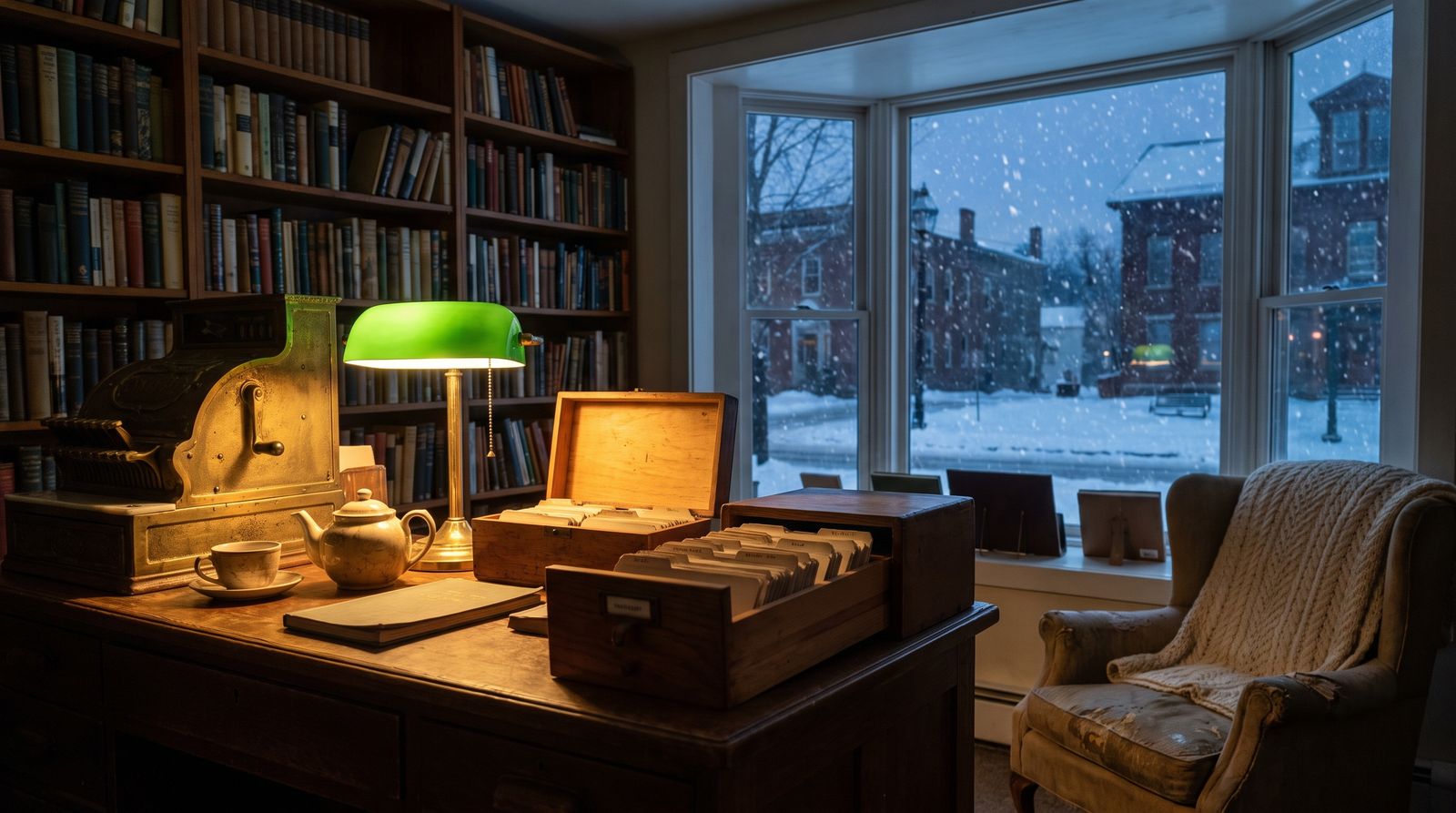
Helen Brig had learned, in one September, that a bookshop could hold a body and still expect her to open on time.
She unlocked anyway. Lift, then left. The key still stuck if you rushed it. She did not rush it. The building smelled like lemon oil and a month of her being here, which was not yet a year and was already a life. Saturday the third of October was not a holiday and not a funeral and not a reason to leave The Lark & Quill dark on a morning when people would want paperbacks and a look at whether the Boston niece had decided to stay.
Pepper was already on the counter. He was a long gray loaf with a white bib and the expression of a librarian who had not approved the last three patrons. He sat on the register’s brass ledge and watched her hang the sign as if the sign were a performance he had seen before and found adequate.
“Staff meeting,” Helen told him. “You are still not for sale. Tom Goss asked again on Thursday, as a joke, and I said no again, as a policy.”
Pepper blinked. She counted that as attendance. She filled his bowl. She counted the float twice because Molly would count it a third time at ten and Helen preferred to be the one who already knew the number. Seventy-five, plus a ten that had wandered in from a man who wanted change for a twenty and then bought a Vermont complaint instead. Honest. She wrote the count on the scrap Eleanor had always used, the one that said Do not make it pretty.
The package was already there.
She had brought the mail in from the box by the door without looking at it, the way you brought in a stack that was supposed to be catalogs and a utility and a flyer for a church supper you would not attend. She had set the stack on the counter beside Pepper and gone upstairs for a sweater that could do October without pretending it was still September. When she came down, the stack had a brown parcel in it that she did not remember giving a place.
Brown paper. Twine that had been tied by a person who believed in knots. In the corner, Eleanor’s old routing stamp—the one Helen had found in the desk in week one and left there because throwing away a dead woman’s tools felt like haste. The stamp was faded. The ink on this paper was not. Someone had used the stamp recently, or had copied the habit well enough to fool a niece who had only been the shop for a month.
She did not open it.
The smell reached her before she had decided not to. Not paper. Not the lemon oil she used on the counter. Not Pepper, who smelled like dust and opinion. Bitter. Greenhouse. The particular chemical green of a hose-end sprayer and a plastic jug with a warning label. It sat in the fibers the way the September clock’s sweet cleaner had sat in its fibers: wrong for a book, wrong for a shop, wrong for a Saturday that had intended to be ordinary.
Helen stood with her hands on the counter and did not slit the paper.
On the twenty-first of September a package addressed to E. Wynn had ticked. Hugh Kline had bagged it and taken it to the station. The clock had been a clock. The lab had said the sweet smell was a cleaner, the kind you used on chrome if you were the sort of person who cleaned chrome. Patricia Holm had called it a sequel joke and told Helen to go sell a book. Helen had sold books. She had written clock, not a bomb; smell, not paper in the notebook and tried to let the line be enough.
This smell was not sweet. This smell was a plant’s idea of a defense.
She called the station because Verna Barrow was already in county lockup and Helen Brig had become the kind of woman who treated odd smells as evidence.
Hugh answered on the second ring. He did not say her name as a question. He said, “Shop or alley.”
“Shop,” Helen said. “Package on the counter. Eleanor’s routing stamp. It smells like a greenhouse and I have not opened it.”
“Don’t.” A pause that was him standing up. “Ten minutes. If Rita’s on the route, keep her off it.”
“I haven’t seen Rita.”
“Good.” He hung up the way he hung up: as if conversation were a tool you put down when you were done using it.
Helen left the parcel where it was. She put Pepper on the hold shelf so he would not sit on evidence. He sat on the hold shelf and looked insulted, which was his usual look. She locked the alley from the inside without opening it. She stood in the front with her hands empty and watched the green do Saturday.
Heddleford in early October had the decency to look like a postcard if you did not know where the tape had been. Maple on the corner. Sam’s chimney already working. Fran’s window still showed a card for Walter Baines, the smile a little more weathered than it had been in September. The November quilt flyer was still on Helen’s own glass, Dot Sewell’s handwriting promising a table and a tin of scraps later. Later was still later. Helen was not investigating a quilt.
Hugh’s cruiser stopped at the curb in nine minutes, which she filed as he was already in the car and then, because she was who she was, filed again as note the time anyway.
He came in without the hat in his hands. Thirty-eight, widower, a face that did jurisdiction for a living. He looked at the package, then at her.
“You didn’t open it.”
“I’m thirty-four, not new,” Helen said. “I inherited a shop and a murder in week one. I can inherit a smell without licking it.”
His mouth almost moved. He put on gloves. He bagged the package the way he had bagged the clock: as if paper could be talked to and would, if you were patient, confess to being the wrong kind of paper. Pepper, from the holds, yawned.
“Same stamp Eleanor used on dealer mail,” Helen said. “I left it in the desk. I didn’t think anyone else wanted it.”
“Someone wanted the look of it.” He turned the bag. “Address.”
There wasn’t one that mattered. Lark & Quill in a block print that was not Eleanor’s slant and not a local hand Helen knew. No return. The stamp in the corner doing the work a return address was supposed to do: this belongs to the old routing.
“September’s was sweet,” Helen said. “This is bitter. I’m not a lab. I’m saying they’re different wrongs.”
“I’ll say it to the lab.” He did not say Vickers. The lab had a last name that was about to become a problem, and neither of them knew that yet. He said, “You open at nine on Saturdays. It’s nine-twenty. Turn the sign or leave it. I’m not your manager.”
“If I leave it, the town will invent a sequel before lunch.”
“Then turn it. Sell a map. If anyone asks why I’m here, I am a man who buys coffee and stands in doorways.”
She turned the sign. OPEN. The lettering on the glass was still gold. The shop still smelled like lemon oil under the greenhouse, which was a sentence she did not like.
On the radio in his cruiser, left low with the door ajar, someone mentioned Boston in the way Vermont mentioned weather. A shooting. No names. Helen filed it under other people’s trouble and did not ask him if he had filed it the same way. Boston could be live without being hers.
He went out to the car for a second bag and a form. She stayed with the counter and the empty place where the parcel had been. She wrote, because she wrote:
3 Oct. Brown paper, routing stamp, greenhouse. Did not slit. Hugh 9:19. Clock package was cleaner. This is not cleaner.
Molly would be here at ten. Molly did Tuesdays and Thursdays and Saturday if the leaves turned. The leaves had turned. Helen would have to say don’t touch the mail without saying we are doing September again. Molly had a short leash and a jar and a habit of counting the drawer as if the drawer might forgive her. Helen did not want Molly’s hands on a smell.
The bell did not ring for Molly.
Rita Finch’s truck pulled up, rural route, fifty-two, a woman who had known Eleanor’s specials by heart. She came in with the cheerful of a person who had already done half a loop and liked this stop because it had a cat. She had a pile in one arm and a question already in her mouth.
“I always check the book mail,” Rita called. “Judy liked a tea sachet in the rare ones. Superstition. I’ll just—”
“Rita,” Helen said, too late, because Rita had already lifted a second, smaller parcel from the box by the door—the one Helen had taken for catalogs—and was tearing the tape with a thumbnail.
Helen had taken the brown one. She had not taken the small one. The small one had been tucked under a seed catalog and a flyer for a supper, as if someone had known a niece in a hurry would grab the obvious and leave the kindness.
The smell rolled out, friendlier. Tea. Or something wearing tea.
Rita held the opened paper the way she held other people’s magazines: as a favor. Inside, a glassine envelope, the kind Eleanor had used for plates, and inside that a sachet tied with baker’s twine. Dried something. Floral if you wanted it to be floral. The greenhouse sat under it like a lie with good manners.
“That’s Judy’s welcome blend,” Rita said, pleased. “I told you I’d tell you if something smelled like that again. This smells like that. She used to tuck one in when a folio went out, or when a folio came in, I never got the rule. Superstition. She said rare books should arrive like guests.”
Hugh came back through the door with the second bag and stopped.
Helen said, “Put it down.”
Rita laughed, not unkindly. “It’s tea, hon. I’ve steeped this with her a hundred times. You look like your sheriff’s about to arrest a bag.”
“Put it down,” Hugh said, and the cheerfulness in Rita’s face did a small, professional adjustment, the adjustment of a woman who had delivered enough bad news on porches to recognize the tone.
She set the opened parcel on the counter. She did not drop it. Rita Finch did not drop mail.
Helen looked at the sachet and at the brown bag in Hugh’s hand and at the box by the door, which was still a box, which had held two parcels when she had thought it held catalogs. Doubled. She did not have the word for it yet as a clue. She had the feeling of a table of contents with a chapter missing.
“I brought the brown one in,” Helen said. “I left the box. I thought the rest was seed catalogs.”
“It was,” Rita said. “And this. Tucked. Judy tucked.” She looked at Hugh. “If you’re going to bag my morning, bag it. I’ve got the hill road after this and the hill road doesn’t wait for a theory.”
Hugh bagged the small parcel without taking the sachet out of Rita’s opened paper. He bagged the paper too. He was thirty-eight and he did not waste time on speeches when the evidence was still steaming with other people’s habits.
“Did you touch the tea,” he said.
“I touched the paper. I always check the book mail. Helen said she wanted a habit that did not include ticking. This didn’t tick. It smelled like Judy.” Rita’s mouth flattened. “I’m fifty-two, Sheriff. I have been this route since before your wife kept the garden club list. I know a welcome blend from a bomb.”
Helen watched Hugh’s face do nothing at the mention of a garden club list. Claire Kline had been dead six years. Illness. Not a plot. Rita had not said it as a plot. Rita had said it as seniority.
“Nobody drinks anything from a parcel I haven’t seen the inside of,” Hugh said. “That’s not a request dressed as a feeling.”
“I wasn’t going to make a pot in your crime scene,” Rita said. “I was going to tell Helen her aunt’s superstition had come back, and then I was going to finish the loop.” She looked at Helen. “You all right? You look like September.”
“I’m all right,” Helen said. She was not all right in the way a shop was all right: open, float honest, a cat on the holds. She was the other kind. The kind that had smelled a greenhouse and then a kindness and did not like them in the same sentence.
A man from the falls wanted a hiking map and found himself in a doorway with a sheriff and a rural-route sub and a woman who was not selling maps at that exact second. He backed out. He would come back. Maps waited.
Hugh said, “I’m taking both. Lab can tell me if your greenhouse and your tea are cousins. You—” to Helen “—keep the box empty until I say. Rita, I want a list of who else on this loop got a parcel that looked like a gift. Don’t play detective. Play memory.”
“I can do memory,” Rita said. “Judy was the only one who put tea in books. If someone else has started, I’ll smell it. That’s my job. Smelling when a box is wrong.”
She said it like a joke. It sat on the counter like a period.
Helen walked her as far as the truck because leaving Rita in the door with a bagged superstition felt like bad manners. The truck smelled like rubber bands and other people’s magazines. Rita put her hand on the wheel and then took it off.
“She really did it, you know,” Rita said. “The sachets. I thought it was cute until I had to explain to a man in Montpelier why his Catesby smelled like a cupboard. Eleanor—Judy, to the route—said if you were going to send a rare thing through the weather, you ought to send a kindness with it. I never liked the smell. I told you that in September. I still don’t. But I know it.”
“This one has a greenhouse under it,” Helen said.
Rita’s eyes went to the shop, to the gold lettering, to Hugh in the glass putting labels on bags. “Then don’t steep it,” she said, and laughed, because laughing was how she left stops that had gotten too heavy. “I’ll check the rest of the loop. If I find another tucked kindness, I’ll call your sheriff, not you. You look like you need to sell a map.”
She pulled away. The hill road, as promised, did not wait.
Helen went back in. Hugh had both bags in one hand and the form in the other. The box by the door was empty except for a seed catalog she had missed and a flyer for a supper she would not attend.
“You going to Burlington,” he said, not as a plan, as a fear he was already managing.
“I’m going to sell a map,” Helen said. “And then I’m going to look at the stamp in the desk and see if it still has ink on it.”
“That’s the first sentence I like.” He stopped at the door. “If the lab calls it cleaner again, I’ll say so. If it calls it something else, it isn’t your morning.”
“It’s my counter.”
“It’s my bags.” He looked at her the way he had looked at her on the twenty-first: locate, assess, do not ask if she was going to faint. “Molly’s at ten?”
“Molly’s at ten.”
“Tell her the mail is closed. Tell her in English.”
“I can do English.”
“I noticed.”
He left. The cruiser took the bags and the radio and the Boston weather that was not weather. Helen stood in the frame until he turned at the end of Main, and then she picked up the seed catalog because leaving it in the box felt like leaving a sentence unfinished.
Pepper came down from the holds and sat on the empty counter. She let him. The tick of September was gone. The greenhouse was gone, into a bag. The tea was gone, into another. What remained was a stamp in a desk and a habit that had just walked back into the shop wearing a dead woman’s nickname.
Judy. Helen had been Eleanor’s niece. The route had been Judy’s. That was a kind of literacy she had not had in September and did not like having now.
She sold the map to the man from the falls when he came back. She did not tell him about sachets. She told him the total. She wrote two parcels, one box, Rita opened the small in the notebook, and under it, tea wearing tea. greenhouse under. stamp.
She did not know, at nine forty-one on a Saturday in October, that the door had already let the wrong guest in.
She knew the stamp was still in the desk. She went to look, between the map and the next customer, and the pad was there, and the ink on the pad was dry, and the pad had been used recently enough that the last impression—if you were an editor who had learned to look at dents—said Lark and then a smear.
Someone had stamped in her shop, or had taken the stamp out and brought it back, or had pressed a copy against the pad to steal the look of a habit.
Helen did not call Hugh about a smear. She had given him two bags. A smear was a later. She put the stamp in the drawer under the OPENING folder and wrote pad used on the scrap, and then she unlocked the mid-room lights and left Folio closed, because Folio was a room and not a place you took a greenhouse.
The first customer after the map wanted a mystery with no swearing and a dog that lived. Helen knew the shelf now. She sold the dog. She did not sell the morning.
At nine fifty-eight she stood in the doorway and watched Rita’s truck, already small on the hill road, and she thought—check the book mail—and she thought—too late—and she turned back to the counter because the bell was about to ring for a clerk who needed English, not a sequel.