Chapter one
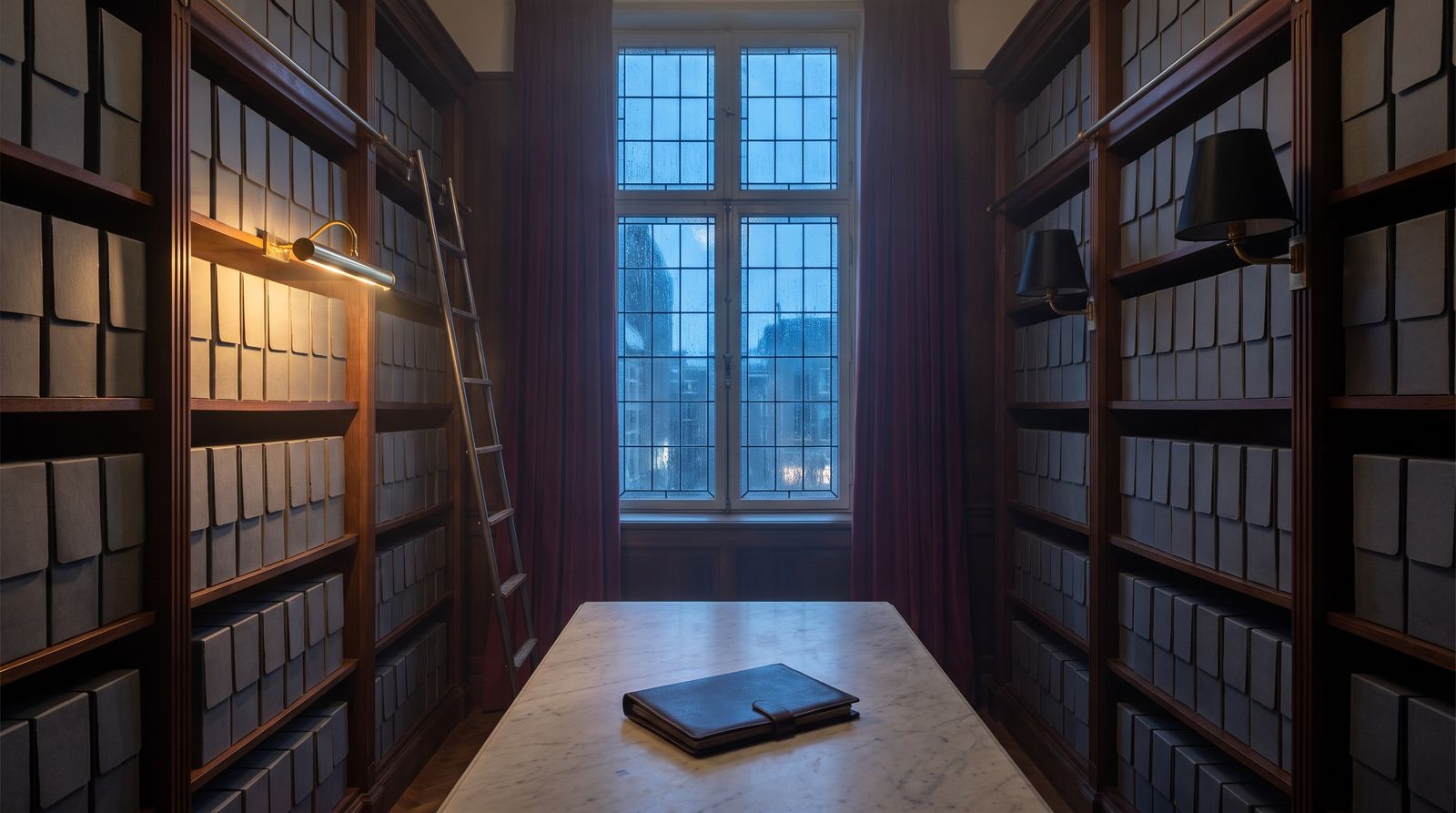
Camille Ortiz was forty and she had not come upstairs to drink.
The Meridian’s locked floor was a rumor members paid for: no phones, no names spoken loud, a ledger in a drawer that Conrad pretended was furniture. November 2027 sat on the windows like wet wool. Hollis Mather was a courtroom caution. Soren’s gallery hooks were empty. The leftover people had moved into the list.
Camille had a board seat and old money and a marriage that had ended in a quiet paper two years ago. She opened the drawer because Bram Ortega, still at the door downstairs, had said if the list is a weapon, someone on the board should hold it before someone else does.
The paper was thicker than taste. Names. Dates. Which member had bought which lie. Which name had paid Hollis. Which name had used Soren’s chute. Which name was only rich.
The dinner she had walked out of had been eight people and a reservation that thought it was a kindness.
Beatrice Ellison at her right, rings to rings when she wanted a point. Giles Pruitt two seats down, a smaller tooth than Edwin, asking whether the club would survive the year the way one asked whether a horse would finish. Claire Dunning across, who still used the hyphen by accident and then corrected herself as if the correction were a gift. James Whitacre at the far end, who collected members the way other men collected plates and was only rich, which was the point of leaving him off four through nine. Duck that tasted like a reservation. A wine Beatrice had chosen. A second wine Camille had not finished.
“You’re quiet,” Beatrice said, when the duck was a wreck of bones. “Is it the Hollis thing? Because the courtroom is a caution now, Camille. We don’t have to carry him at dinner.”
“I’m not carrying him,” Camille said. “I’m carrying a drawer. There’s a difference.”
Giles laughed as if she had been witty. “The club is a building,” he repeated, because she had said it already and he liked sentences he could take home. “Buildings survive. People make weather in them. Pierce says you’re having a fashion about the weather.”
“Pierce sends wreaths,” Camille said. “I don’t take weather advice from wreaths.”
Claire’s mouth made the hyphen shape and then unmade it. “We only mean you shouldn’t be alone with the year. It’s November. People do rash things in November.”
“I’m forty,” Camille said. “If I do a rash thing it will be a decision. Pass the wine if you’re going to narrate my calendar.”
James lifted his glass to no one. “Taste is a moral system,” he said, and no one answered him, which was the correct fate for that sentence even before a booth would ignore it later.
Beatrice touched her wrist. “Standards, Camille. Not fashions. I told Pierce you have standards.”
“Standards include not paying a courtroom caution after the courtroom has started.” Camille stood. The table looked at her as if dessert were a vote. “I’m going upstairs. The club is a building. The drawer is not. Don’t wait the second wine for me.”
Bram’s text was already in her coat: locked floor. tonight. you. She left before the plate of something citrus could arrive. In the car she looked at her hands. Marriage hardware gone two years. Board hardware remaining. She had not yet known a thief would be in the room. She had known, already, that she was tired of being furniture that voted.
Bram Ortega did not waste sentences. He had a completed book and a man he went home to, and he still stood the door because Conrad paid him to decide who was a member and who was a problem. Camille had known him long enough to trust the difference.
The Meridian sat above a Midtown hotel that had been fashionable in three different decades and was fashionable again because Conrad had decided it should be. The public rooms downstairs were gold and low light and the particular hush of people who had never been told no in a restaurant. Camille had walked through them with her coat still on. She did not hang coats for other people’s eyes. Inez at the bar had nodded. A publicist in a dark coat—Eve Shaw, if the gossip was current—had been taking a note near the cloakroom and had not looked up. Conrad had been a shape at the far end, forty-eight, a man who had named a building and not yet decided if the name still fit.
Camille had not stopped for any of them.
The elevator to the locked floor required a key the board issued like a sacrament. Camille’s key was older than most of the new memberships. It had been her father’s, then hers, then a thing she carried because the alternative was letting other people decide what the drawer meant. The car smelled like citrus oil and someone else’s perfume. She rode it alone and felt forty in her knees and in the way she did not rush.
The locked floor was one room and a corridor and a bathroom that members treated as a secret. No cameras. Bram’s rule, Conrad’s allowance. Phones in a box by the door if you were obedient. Most people were not obedient. They were rich, which they confused with the same thing.
The drawer was walnut. Conrad had once said, in a meeting that had been about insurance, that it was a humidor. It was not a humidor. Camille had known that since 2019, when a previous board chair had shown her the first page the way a man showed a woman a scar he was proud of.
She had not been proud. She had been useful. There was a difference, and the board liked the difference on her.
Arthur Vane had been sixty-six and the chair of a board she had joined eleven weeks earlier, in the seat that had come free when her father stopped being able to attend and then stopped being able to be told he was not attending. October 2019. A members' dinner that had run to speeches. Camille had been thirty-two and two years married and very good at the half-smile that let a table believe it had been charming.
“Walk up with me,” Arthur had said, at the coats. “I want to show you the part of the job nobody puts in the letter.”
The locked floor had smelled the same then: citrus oil, radiator, the particular dryness of a room with no cameras in it. Arthur had used a key that had been his for nineteen years. He had not made a ceremony of the drawer. That was the thing Camille had not been prepared for. She had expected theater. She got a man opening furniture the way a man opens a filing cabinet in a business he is proud of.
“Page one,” he said, and turned it toward her, and stood back so she could read it without his shoulder in the light. “Go on. It doesn't bite. It's the reason this club has never had a scandal in ninety years, which is a sentence I would like you to hear before you decide what you think of me.”
She read. Cotton stock, a hand she did not know, dates going back further than the hand. Names she had eaten dinners beside. A note in the margin beside one of them: declined 2014, quietly, no letter.
“That's a rejection,” she said.
“That's a mercy. He was going to be arrested in eleven months. If we had taken his money we would have had to give it back in public.” Arthur turned two pages with one finger. “A club that knows what its members are is a club that can decline them quietly. A club that doesn't know is a club that finds out in a newspaper with everyone's name attached to the wrong one. The drawer is not a weapon, Camille. It is why nobody has ever needed one.”
She had almost believed it. That was the part she would not forgive herself for later: not that she had been shown the drawer, but that for about ninety seconds, in a room that smelled like citrus oil, the argument had been good.
“Who else has read it,” she said.
“Chairs. Two stewards, dead now, one of them badly. Conrad, who calls it a humidor in insurance meetings and means it as a joke and is not certain it's a joke.” Arthur had watched her the whole time. Not the way men watched her at dinners. The way a man watches a lock he has just handed someone the key to. “And you. As of tonight.”
“Why me. I've been on this board eleven weeks.”
“Because of page two.”
He turned it. He did not point. He did not have to. Third block down, in the older hand, the one that had written the dates before anyone thought the dates would matter: *Ortiz. Not her. Her grandfather, and then her father, and then, in an ink that was three years old at most, a line underneath in the newer hand that had her own initials on it, and beside the initials the word board, and beside that the word clean.*
“We're not a crime,” she said. Her voice had come out level. She had been proud of that for years afterward and then, later, ashamed of having been proud of it.
“No. You're money. Money is on page two because money is a fact and the drawer is a record of facts.” Arthur closed it with two fingers, which was where she had learned to close things with two fingers. “It is also why I can hand you this and sleep. A steward who is not in the ledger is a steward who can be righteous about it. Righteous men leak. You're in it. You will be careful with it. That is not a threat, dear. That's architecture.”
The word architecture had sat in her for eight years. She had used it herself, in a back hall in September, about a camera's blind spot, and had not noticed where she had got it from until she was forty and standing on the same floor with the same drawer under her hand.
“And if I decide the architecture is a fence,” she had said, at thirty-two, in a coat she had not taken off.
Arthur had smiled the smile of a man being asked a question he had asked himself once and answered comfortably. “Then you'll be the first. And you'll be voted off in a spring meeting and someone with a longer marriage will hold the key, and the drawer will still be here, and you will have changed nothing except your own dinners.” He had put the key back in his pocket. “Go home to your husband. You did well tonight. The Whitacres think you're a natural.”
She had gone home to her husband. She had not told him. That had been the first thing she had not told him, and she had not understood, at thirty-two, that it was the beginning of a list.
Arthur Vane had died in 2023 and the club had sent an enormous arrangement, and Pierce Holcomb had spoken at the service about stewardship, and Camille had sat in the fourth row with her hands in her lap and thought about page two, which is a thing you can think about for an entire eulogy without moving your face.
She had opened the drawer because Bram was right. Hollis Mather had gone from a collector who could ruin a room to a name lawyers said carefully. The leftover people—buyers, chute men, the ones who had used Fenwick House and Soren’s hooks and a dead painter’s silence—had not evaporated when the courtroom started. They had condensed. They had become a list.
The paper was heavier than it needed to be. Cotton stock. Dates in a hand that changed twice, which meant two stewards, which meant the club had been doing this long enough to train replacements. Camille read standing up, because sitting for a ledger felt like prayer and she did not pray to furniture.
Pages one through three were the only-rich: donors, widows, a restaurateur who collected members the way other people collected plates. Their sins were taste and tax and the ordinary cruelty of having too much. Fenwick House had refused to slaughter that kind of name. Nell Brennan had published a true version of a different crime and then gone home to a man who was not Camille’s problem. The club was supposed to learn the same lesson. It had not. It had put the lesson in a drawer.
Pages four through nine were the leftover mouth. Hollis’s buyers. Transfers that had been called gifts. A warehouse invoice that had been called a dinner. Camille’s old circle lived in the margins—initials she recognized the way one recognized a coat in a restaurant. Pierce Holcomb was on page six, fifty-eight, chute money, a man who had once told Camille’s mother that women on boards were a fashion. He had used Soren’s chute. He had paid Hollis. He had a note in the steward’s hand: circle. do not file.
Camille filed it anyway. In her head. That was what a board seat was for, if it was for anything.
She was on page seven when she understood she was not alone.
The understanding was not sound. It was air that had been recently occupied. A heat that was not the radiator. Camille did not startle. Starting was a young woman’s luxury. She closed the page with two fingers, turned, and found the thief.
Yasmin Reid stood as if the room had been built around her decision to be in it. Dark hair, not the expensive kind of undone—the kind that had been done and then used. A dress that had cost a software exit. Jewelry that had not inherited anyone. She was beautiful in the way new money was beautiful when it stopped asking permission: precise, a little sharp, a mouth that had learned to say no in rooms that preferred thank you.
Camille’s body did a stupid thing. It wanted. Immediately. Not the polite want of a dinner, not the filed want of a decade of looking and not touching. This was inconvenient and adult and it arrived in her throat.
She closed the drawer.
“You’re Camille Ortiz,” the woman said, and the rest of it—the photograph, the threat, the key bought to unprotect—landed like a contract someone else had already signed.
Camille let the name sit. She had been Camille Ortiz for forty years and Camille-hyphen-someone for eight of them and then Camille Ortiz again, on paper, in a lawyer’s office that smelled like lemon and endings. The board still introduced her with the marriage sometimes, as if a dead contract were a courtesy. She did not correct them at dinners. She corrected them here.
“If you photograph a ledger in my building,” she said, “you will not leave as a member. You will leave as a problem.”
Yasmin’s eyes were very dark and not sorry. “I’m already a problem. I paid to be. Sit is a generous verb. I can stand.”
“Sit is not generous. Sit is how I decide whether I call Bram.”
Yasmin sat. The sofa had seen worse decisions. Camille remained standing because height was a tool and she was not above tools. She was above pretending she did not use them.
“Which names,” Camille said.
“The ones that used people as wash.” Yasmin’s voice had a clean edge, new-money trained, not debutante. “The ones that paid Hollis after the courtroom started, which means they paid him to stay a caution instead of a sentence. The ones that used a gallery chute when the gallery was still a fence. I didn’t come for widows who overtip. I came for the mouth.”
“You came with a camera.”
“I came with a phone. I used it. I can use it again.” Yasmin tipped her chin at the box by the door, empty. “Your sacrament is a box. I don’t put tools in boxes.”
Camille looked at her hands. No wedding hardware. A watch that was a statement about exits. Nails short enough to work. The almost of want moved lower, unhelpful. Camille filed it harder.
“Show me you understand the difference,” Camille said, “between a leak that finishes a spine and a leak that burns a building so you can feel righteous in a rideshare. If you don’t understand that difference, I will have Bram walk you out and I will still be the woman who opened the drawer. If you do, we will talk like adults who are about to become a mistake.”
Yasmin laughed once, quiet. “You talk like a board seat. I was warned.”
“By whom.”
“By the membership officer who sold me the key and thought he was selling a party. He said you protect names. He said it like a compliment.” Yasmin’s mouth did that thin interested thing again. “I don’t compliment protection. I audit it.”
Camille walked to the window because the alternative was walking to the sofa. Midtown in November was a wet grid. The hotel’s sign threw gold on the glass. Somewhere below, Inez was pouring for people who thought the locked floor was a myth they had already bought. Somewhere in a different borough, Hollis Mather’s lawyers were teaching him how to say no comment as if it were taste.
“Hollis is a courtroom caution,” Camille said, to the glass, to the thief. “He is not a sequel I am writing. The leftover people want him to be a weather system they can wait out. They are on four through nine. The chute is six. If you leak the rest, you do what Fenwick House refused to do, and I will not help you slaughter innocents to make a point about class. I have class. I am not confused about it.”
“I’m not asking you to be confused.” Yasmin’s voice had come closer. Camille did not turn yet. “I’m asking you to be a match. You opened the drawer. That is not a board motion. That is a woman who is tired of being furniture.”
Camille turned.
Yasmin had not stood. She had leaned, which was worse. The lamp found the line of her throat. Camille’s rings felt suddenly like an audience.
“I’m forty,” Camille said, because ages were a contract and she would not let this room pretend she was a lesson. “If you came to fuck the old money into a leak, you came to the wrong locked floor.”
“I came to steal a list.” Yasmin held her gaze. “The rest is a later mistake.”
The later sat between them like a third drink. Camille could have ended it. She could have called Bram. She could have taken the phone, deleted the photograph herself, and written a letter to the membership officer about selling keys to thieves. She could have gone home to a penthouse that did not steal members and a bed that had been a country of one for two years.
She sat down instead. Not on the sofa. On the chair opposite, knees together, a lie she had been telling rooms since she was twenty-five and someone had told her that posture was virtue.
“Then we will talk names,” Camille said. “You will tell me which page you photographed. You will tell me why your first company is in your mouth when you say wash. You will not touch the drawer again without me. If those terms are too much board, the elevator is behind you.”
Yasmin’s smile sharpened. “My first company is a later chapter. The photograph is page one. I wanted you to know I could. I don’t need page one. I need four through nine, and I need a woman on the board who will not faint when the right names leave the building.”
“I don’t faint.”
“I know. That’s why I waited.” Yasmin glanced at the drawer, then back. “I could have been gone before you arrived. Bram told you to come. I heard the elevator. I stayed. That’s the part you should file, Camille. Not the camera. The stay.”
Camille filed the stay. She filed the want. She filed the fact that her name in Yasmin’s mouth had landed like a hand.
“If you stay,” Camille said, “you stay as a member who is about to become my problem. Not as a performance of theft. I have seen performances. I sat through a marriage of them.”
“I’m not a performance.”
“Good. Performances are easy to evict.” Camille set her rings on the arm of the chair, a small sound, gold on wood. “We talk. Then I decide if I am a board seat or a match. You don’t get to decide for me by sitting beautifully on a sofa that has seen worse.”
Yasmin’s laugh this time was real, brief, a crack in the new-money finish. “Beautifully. That’s the first honest thing you’ve said that wasn’t a threat.”
“It wasn’t a compliment. It was an inventory.”
“I’ll take inventory.” Yasmin leaned back, which did not help the want. “Talk, then. I’ll tell you about the wash. You tell me which names you already knew were crimes. Then we will both pretend the heat in this room is the radiator.”
Camille did not pretend. She was forty. Pretending was a younger habit.
“The heat is not the radiator,” she said. “I am filing it. You will file it. If we fail to file it, we will do something the board will call compromise and I will call a body. That is a later mistake. Tonight is paper.”
Yasmin looked at her mouth, honest enough to sting, and then at her eyes.
“Tonight is paper,” she agreed. “I’m still going to want the later mistake. I’m thirty-four. I don’t lie about want to women who can end me with a phone call.”
“I haven’t called.”
“I know,” Yasmin said. “That’s the problem I’m keeping.”
They talked names for another twenty minutes because paper was the excuse that kept their mouths apart.
Yasmin told the wash without theater. Northspan had been a clean product: a ledger tool for people who hated ledgers, a small team, a year of being told she was a miracle for not inheriting a board. Then diligence found invoices that looked like consulting and a mentorship program that had moved other people’s money through her rails. Pierce Holcomb’s people. Hollis Mather’s orbit, even after the courtroom had started teaching lawyers how to say his name carefully. Yasmin had sold anyway. Selling was how you survived a stain you had not put there.
Camille did not offer sympathy. Sympathy was a circle habit. She offered a map.
“Holcomb is page six,” she said. “Chute. Circle. He sat at my mother’s table and told her women on boards were a fashion. He still sends wreaths. Lyle Osgood collects painters the way other men collect boats. Tomas Riegel bought a silence from a Fenwick House intern in 2019 and called it a kill fee. Petra Venn moved Hollis’s money through a foundation that funded dinners. Edwin Pruitt bought a silence in 2018 and called it a scholarship. Nia Holst used the chute to move a canvas that was not a canvas. Those are four through nine if you are precise. The rest of four through nine is smaller mouths with the same teeth.”
Yasmin’s eyes had gone sharper, not softer. “You already knew.”
“I opened the drawer. Knowing is what a board seat is for if it is for anything. Acting is what I had not done, because acting makes you a match, and a match can be voted out.” Camille’s rings tapped the chair once. “I am tired of being furniture that votes. That is not your victory. That is my age.”
“I’m not here for a victory lap on your age.”
“Good. I would evict that too.”
A vacuum started somewhere in the hotel and then thought better of it. The locked floor held its own air. Camille stood and walked the length of the room because sitting had become a kind of leaning. The bathroom door was ajar; she could see marble and a towel that had been folded by someone who still believed in rituals. She did not go in. She came back to the chair.
“Private room,” she said. “After hours. We mark what you just heard against what you printed in your head. If you photograph the drawer again, I will stop being interesting and start being a board. If you ask for a mouth tonight, I will say not yet, and I will mean not yet, and I will still want it. Those are different sentences. Learn them.”
Yasmin stood. They were closer than the room required. New-money perfume, something like vetiver that had been chosen and not inherited. Camille’s body filed it and then failed to file it.
“I can learn two sentences,” Yasmin said. “I’m thirty-four. I learned a cap table. I can learn a woman who talks like a contract.”
“I talk like a contract because contracts kept me alive in rooms that preferred photographs.” Camille went to the door. “You first. I will wait ninety seconds. Eve Shaw is downstairs with a notebook. Conrad is a shape at the bar. Neither of them gets this floor tonight.”
Yasmin paused with her hand on the frame. “If I stay ninety seconds, you’ll think I’m performing.”
“If you leave on my count, I’ll think you can take an order. I have not decided which I want.” Camille’s mouth almost moved. “Go.”
Yasmin went. The elevator took her. Camille stood in the locked floor alone with the drawer and the sofa and the want, and she counted to ninety because she had said she would, and because counting was a way not to open the drawer again and put her mouth on a problem.
She rode the staff stair down. The public rooms were still doing their hush. Inez caught her eye and did not pour; Inez had worked the Meridian long enough to know when a board seat had not come to drink. Bram, at the door that was not a door members used, said, “She’s a member. She’s also a theft. You know that.”
“I know.” Camille put on her coat. “If the list is a weapon, I am going to hold it. If she is a weapon, I am going to decide whether I am the hand. Don’t put that in a report.”
“I don’t write reports about your hands,” Bram said. “I have a man at home and a completed book. I turned a camera off once for a different hinge. I will not make a habit of blindness.”
“I’m not asking for a habit. I’m asking for you to remember who opened the drawer.”
Bram nodded once. That was as much blessing as security gave.
Outside, November made a mess of the avenue. Camille’s car was waiting because her car always waited; that was old money’s least interesting magic. She sat in the back and did not call Marisol. She did not call the circle. She looked at her own wrist, at the gold, at the place Yasmin had not touched, and she said, to the privacy screen, to no one, “I am not a museum.”
The driver did not answer. Good. She was forty and she was going home to glass, and tomorrow a thief was going to arrive at noon with yellow pages, and Camille Ortiz was going to decide if she was a board seat or a match, and she already knew the answer, which was the problem she was keeping.