Chapter one
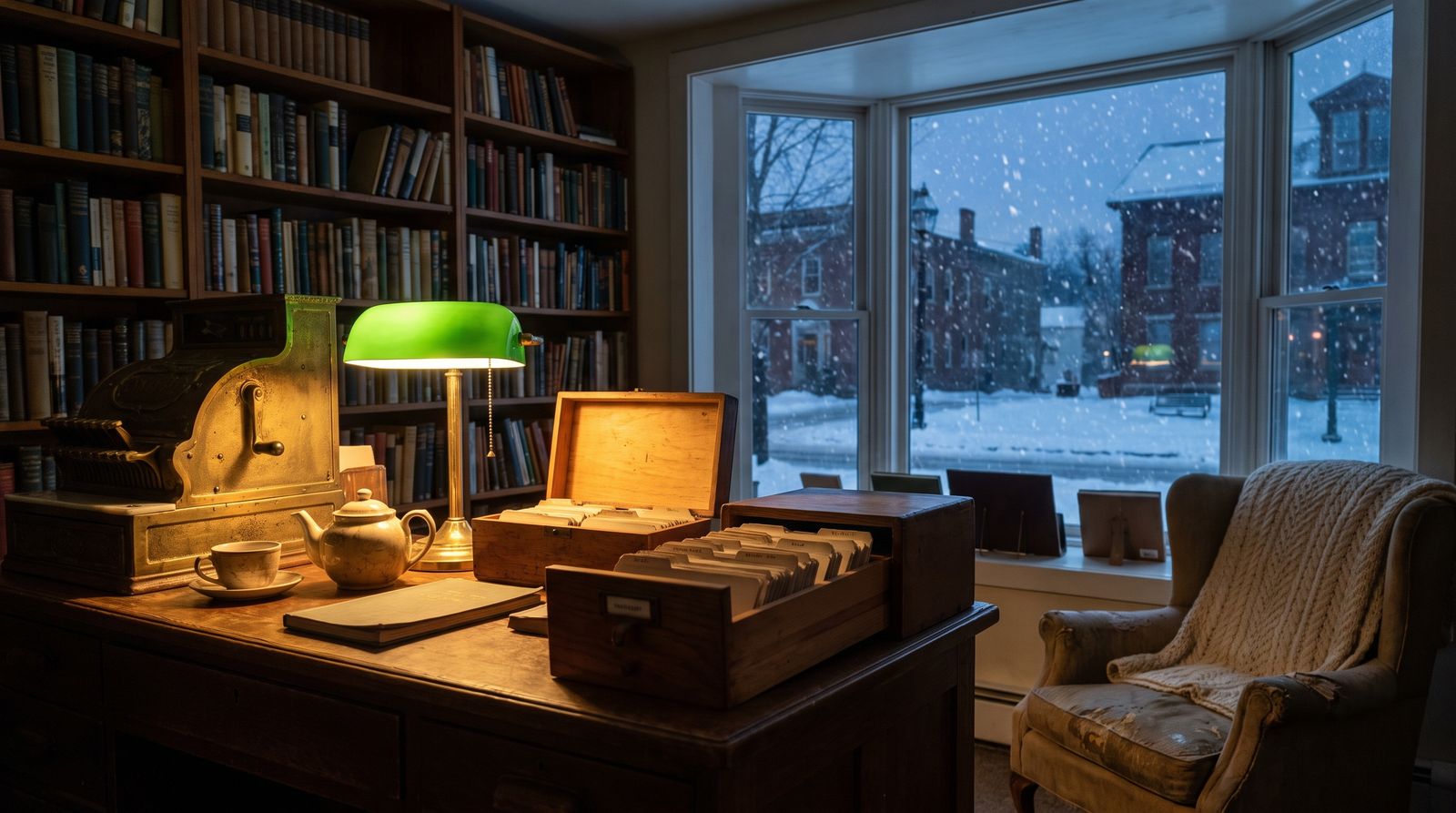
Patricia Holm met her at the diner because the shop, Patricia said, should be entered the first time without an audience.
“You’ll have one soon enough,” the lawyer added, stirring sugar she did not need. “Eleanor knew everybody’s holds. They’ll come to see if you alphabetize.”
Helen Brig was thirty-four years old and she had driven up from Boston with a cardboard box, a dying air conditioner, and a resignation that still felt like a draft. She ate eggs she did not taste. Across the green, The Lark & Quill sat in its brick the way it had sat in every childhood August: gold lettering, a window display of faded maps, a CLOSED sign that had been true since February.
Fran’s was the kind of diner that had decided, decades ago, that menus were a courtesy and not a negotiation. The booth vinyl had a split that someone had mended with tape the color of a Band-Aid. A campaign card in the window showed a man named Walter Baines shaking a hand that did not belong to anyone Helen knew. She looked at the card once and then at her eggs, because she had not come to Heddleford to vote.
“The float is in the drawer,” Patricia said. “Utilities are current. Pepper has been with Tom Goss at the hardware, who would like you to know the cat is not for sale and neither is his opinion of Boston. Keys.” She slid an envelope across the formica. “Lift, then left. Eleanor wrote that down as if you might try to rush a lock. She was very fond of you and very unimpressed by haste.”
“I know,” Helen said. “I edited haste out of other people’s books for twelve years.”
Patricia’s mouth moved in something that might have been sympathy if lawyers were paid for it. “Ice is ice, Helen. The report is in the file if you want it. She went out the side path after close. February. It happens.”
It happened. Helen nodded, because nodding was cheaper than arguing with a file she had not read. Patricia had brought a copy anyway, in a second envelope, as if envelopes were how Vermont delivered grief. Helen did not open it at the table. She put it under the box.
The diner had a radio on low, a morning show that believed in weather and farm prices. A woman two booths over said the niece without lowering her voice. Patricia did not turn. Helen did not either. She had been the niece in this town since she was nine and arriving for August with a duffel and a stack of paperbacks Eleanor had already chosen.
“The apartment is legal,” Patricia said. “Smoke detectors, the works. Eleanor lived over the shop for twenty-nine years. If you decide the stairs are a season and not a life, call me before you list anything. The town has feelings about the lettering.”
“I’m not listing anything.”
“That’s what people say in week one.” Patricia signed the check. “Molly Reeve has a spare key and a habit of Mondays. She’s young and she liked Eleanor. If the float is short, assume incompetence before crime. I say that as a lawyer and as a woman who has hired students.”
“Does she live in town?”
“Over the hardware, with a roommate who works Fran’s night shift. Tom Goss is not her father, before you invent a family tree. He’s just the man who had the cat and a front key for feeding. Molly does Tuesdays and Thursdays too, and Saturday if the leaves turn and the day-trippers remember we exist.” Patricia tucked her pen away. “She’ll be here at nine if she’s herself. I told her you’d be in. I did not tell her to perform grief. She’ll do that on her own.”
Helen paid for the eggs. She left a tip that was Boston-large and then, because she was already tired of being from somewhere, she did not take it back. She crossed the green with the envelopes and the box and the particular quiet of a woman who had decided, on a Sunday night in a studio in Jamaica Plain, that she was done waiting for a better week.
The green was a rectangle of grass and a war memorial that needed new gold on the names. A maple on the corner had not decided on color. The bakery chimney—Oven Door, if the painted board was still honest—already smelled like butter. A sheriff’s cruiser rolled past without hurry, which she filed as not my business and then, because she was who she was, filed again as note the car, note the hour.
The key was older than her adulthood, and it stuck.
She jiggled. She swore, mildly. She did what the note said and did not rush it.
The tumblers gave.
The smell met her first. Lemon oil. Old paper. A thread of something dry and floral that Eleanor had used in the vacuum bag so the shop would not smell like a basement. Helen stood on the threshold with the box and let it hit her in the chest, because there was no way around it and she had never been a woman who pretended otherwise.
“All right,” she said to the empty room. “I’m here.”
Pepper appeared from behind the counter as if the sentence had been a summons. The shop cat was a long gray loaf with a white bib and the expression of a librarian who had not approved the last three patrons. He sat. He looked at Helen. He looked at the box. He did not move.
“I’m Helen,” she told him. “Eleanor’s niece. I am thirty-four, I drove four hours with a dying air conditioner, and I am your problem now.”
Pepper blinked, which she decided to take as a lease.
The shop was narrower than memory and exactly as deep. Front room: used paperbacks, a spinner of local hiking maps, a counter with a brass register that had been old when Helen was in college. A jar of stub pencils. A ceramic dish of paper clips that had become a single fossil. Mid room: fiction in the order Eleanor had invented and refused to explain, a fat Fenwick House paperback with a silver fox on the spine sitting between two mysteries as if it had wandered in and been allowed to stay. Back: a doorway with a carved lintel that said FOLIO in letters someone had gilt a long time ago and then let dull.
Helen set the box on the counter. She did not go to Folio yet. She walked the front the way she had once walked a manuscript: slowly, looking for the place the argument failed.
The window display was maps and a cracked baedeker and a handwritten card in Eleanor’s slant that said ask about the falls. The card had curled at one corner. Helen left it. Correcting a dead woman’s window on the first morning felt like the kind of haste Eleanor had written the key note against.
Eleanor had died in February. Ice, the lawyer had said. A fall on the side path. Ruled an accident. The will had taken the summer to clear because Vermont did not hurry and because Helen had been in Boston finishing other people’s books and telling herself she would come when she could come properly. Properly had turned out to be the first Monday in September, a rental car that smelled of other people’s coffee, and a resignation letter she had written on a Sunday night after a meeting about “list vitality.”
She was not here to be charming. She was here because the shop was hers, and because she had spent twelve years taking apart sentences, and because someone had to turn the key.
The apartment was upstairs: a kitchen the size of a generous closet, a bed that still had Eleanor’s quilt, a window that looked over the alley and a slice of the town green. The stairs announced every foot. Helen put her clothes in the dresser without unfolding the tissue. She found a bag of cat food under the sink and filled a bowl that already had Pepper’s name worn into the glaze. She stood at the window and watched a man walk a dog that had opinions about a squirrel.
Heddleford was doing what small towns did on a Monday in early September: not much, and all of it visible. Fran’s card for Walter Baines caught the light and threw it back cheap. A woman in a good coat crossed toward the inn two streets off—Clay’s, if childhood still mapped right—and did not look at the shop. Helen did not need her to. Day one was not for collecting the town.
She went back down because the box on the counter was a claim and she had not finished walking the claim.
The register drawer stuck the way the door had. Empty except for a roll of ones and a handwritten float count in Eleanor’s slanted print: $75. Do not make it pretty. Pretty is how twenties walk. Helen found the lights. She found the thermostat, which had been left at a number that assumed a woman who felt the cold in her hands. She found, in the desk under the counter, a folder labeled OPENING in the same hand, with a list that assumed the reader already knew where the spare bulbs lived.
Lights. Float. Pepper. Sign. If Molly is late, she is at the hardware arguing with Tom about tape. Do not alphabetize. People will test you. Folio stays closed until you have read the list.
There was no list in the folder.
Helen sat on the stool Eleanor had used and let her hands rest on the wood.
“I am not going to cry on the register,” she told Pepper. “It would be bad for the keys.”
Pepper jumped onto the counter and sat on the folder. That, too, was a kind of permission.
In the mid room she ran a finger along spines. Eleanor had bought what people actually read: mysteries with cracked hinges, garden books with soil in the gutters, a run of Vermont town histories that looked as if they had been consulted for arguments. The Fenwick House novel had a receipt tucked in it from a shop in Montpelier, dated last November. Eleanor had not been precious about trade paperbacks. She had been precious about the back room.
Helen stood in the Folio doorway and did not cross the line.
The room was cooler. Oversize shelves. A locked glass cabinet. A library stool with one worn step. A pair of marble bookends shaped like owls, ugly and expensive. The air smelled more of leather than of lemon. On the nearest shelf, face-out, a heavy volume in faded green cloth: Hollins, Birds of the Northern Grants, 1819. She did not touch it. She did not know enough yet to know whether she was allowed.
“Tomorrow,” she said, and then corrected herself, because it was already today and she was not a woman who left a room unnamed. “Later.”
She crossed the line anyway, one step. The floorboards were quieter than the front. Eleanor had laid a runner that had gone threadbare in the place a person stood to look at the cabinet. Helen did not open the cabinet. She did not touch the owls. She read titles with her eyes: local histories too fine for the mid room, a broken set of plates, a quarto wrapped in brown paper that said DO NOT SHELF in Eleanor’s print. She left the quarto alone. She left the Hollins face-out, which already felt like a mistake, and went back to the lintel.
In the office closet she found the desk, the green lamp, a stack of dealer catalogs, a laptop that belonged to 2014. She did not turn the laptop on. Morning one was for keys and smell and the cat. Morning one was not for other people’s invoices.
She sat in the office chair anyway, because a chair was a kind of claim, and she opened the top drawer the way she opened a manuscript: expecting paper clips and finding a life. Stamp pad. A roll of twine. A broken letter opener Eleanor had refused to replace because the break had a useful edge. A photograph, facedown, of the green in winter, the shop lettering half-lost in frost. Helen turned it over and put it back facedown. She was not ready for Eleanor’s idea of winter.
The catalogs were a geology. Boston. New York. A Montpelier list with a coffee ring. She read spines, not pages. Barrow Fine Books appeared twice in the stack, which she did not yet know was a sentence. She closed the closet on them.
Childhood Augusts had happened in the front, not in Folio. Eleanor had let her read on the stool and had not let her price. You have an eye, Eleanor had said, the summer Helen was sixteen and already correcting other people’s commas in the school paper. An eye is not a valuation. Don’t confuse them. Helen had been offended, then grateful, then Boston, then a woman who confused them for a living in a different direction.
She walked the mid room a third time and tested Eleanor’s order by trying to break it. The British trains belonged together. The Vermont complaints belonged together. The garden books belonged together because they had all been owned by people who put them in dirt. There was a logic. It was not a logic you could write on a sign for tourists. People would test her, Tom had not yet said. People would test her anyway.
The Fenwick House fox had a cracked corner on the back cover. She left it. A tourist book with a receipt from Montpelier was a fact about Eleanor’s last November, and November was not this morning.
She stood at the front glass and looked at her own face in the gold lettering, which was not a mirror scene, only a check that she was still a person who had driven four hours and not a rumor the diner had invented. She looked like a woman who needed coffee she would not go back to Fran’s for, because going back would be an audience.
Pepper followed her to the glass and sat on her foot. She did not pick him up. He was not a comfort object. He was staff.
Before Molly, she walked to Goss Hardware, because a cat who had been boarded was a fact that wanted a handshake even if the cat had already clocked in. The hardware was a long room that smelled of oil and rope. Tom Goss was sixty and built like a man who lifted paint cans for a living. He looked at Helen’s Boston shoes and then at her face and decided the face was closer to Eleanor’s.
“He’s been eating,” Tom said. “I don’t do pets. I did Eleanor a favor. You’re the niece.”
“Helen. Thank you for Pepper.”
“Thank the cat. He came back here twice after the funeral like he was checking the inventory.” Tom wiped his hands on a rag that had given up. “Sorry about February. She was careful on that path. I told the sheriff that. He wrote it down. Writing it down isn’t the same as believing it, but Kline writes everything down. You’ll meet him. He rolls past at eight and at dusk. Habit.”
“I’ll keep the lights honest.”
“Do. And don’t alphabetize the mysteries. Eleanor had a system. People will test you.” He glanced at the street. “Molly’ll be over. She’s my tenant, not my project. If the float’s short, you talk to her before you talk to the town. Town likes a story.”
Helen bought a pack of bulbs she did not yet need, because you did not leave a hardware empty-handed in a town this size. On the way out a man in a delivery jacket came through with a dolly and a nod for Tom. Tom said, “Reeve,” the way you said a last name you had said a hundred times, and the man said he was early for the bakery and late for everyone else. Helen filed Tom Reeve as a voice and a dolly and not a conversation. She walked back under the maple that had not decided on color.
The side path was still there: a strip of flagstone between the shop and the alley, the place February had used. Helen did not walk it as a pilgrimage. She walked it because it was the way to the alley bolt, and because she wanted to know how the stone felt in September. Dry. A little moss. Nothing that explained a careful woman.
She did not go back upstairs to unpack the rest. She opened Patricia’s second envelope at the counter, standing, because sitting would have made it a ceremony. The report was short and sure of itself: ice, side path, no witnesses, no foul play indicated. Eleanor Wynn, 61. A photograph of a boot print that meant nothing to Helen except that the boot had been good. She put the report back in the envelope and the envelope in the desk, not under socks, not yet. Day one was for knowing where the paper lived.
She made tea in the pot under the counter—Eleanor had kept a second kettle for the shop, because customers who argued about margins were easier if they had a mug—and she drank it standing up. The tea was old. She drank it anyway. Pepper watched as if scoring her.
“I edited other people’s books,” she told him. “I am going to sell other people’s books. If you have a complaint about the brand of food, file it in writing.”
He closed his eyes. She took that as a pass.
Outside, Heddleford kept its Monday. A school bus groaned at the far end of Main. The Oven Door door opened and shut on a person in an apron Helen did not yet have a name for. The cruiser did not come back. The Baines card in Fran’s window stayed where it was, smiling at a green that had not asked for a smile.
Helen Brig, thirty-four, ex-editor, current shopkeeper, stood in her aunt’s front room with a key that stuck and a cat who had already decided the terms. She thought about the Hollins, which she had not opened. She thought, briefly, about the ice in February, and then she put that thought on a shelf in her mind where she put things that did not yet have enough evidence.
She unpacked the last of the box upstairs after the tea, because a skillet on a dead woman’s stove was a decision and she had already made it. The photograph of August went on the kitchen shelf. Two Helens, two books, a green that had not yet learned yellow tape. She did not cry on the skillet. She ran water until it came clear, which took longer than Boston, and she set the pot to dry on a towel that had Eleanor’s monogram faded to a rumor.
From the alley window she could see the back of Fran’s, a dumpster, the municipal lot’s far corner, the inn’s white shoulder two streets off. She could see the path. She did not photograph it. She was not a tourist of her own grief.
The bell had not rung. It would. Patricia had promised an audience.
Helen turned the sign in her hand and did not hang it yet. Nine o’clock was for Molly and the spare key and the test of whether she could be a person who opened a shop instead of a person who closed a manuscript.
She hung the OPEN sign at nine, lift-then-left still in her wrist, and waited for the first person who wanted to see if she alphabetized.